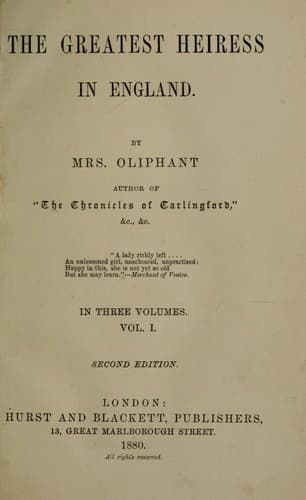
The Greatest Heiress in EnglandOliphant, Mrs. (Margaret)
General
The Greatest Heiress in England
Oliphant, Mrs. (Margaret)
England -- Fiction; Inheritance and succession -- Fiction
And though this annoyance was not at all of the kind he
imagined, it was still good for her not to be left to invent little
speeches to be made to Mrs. Russell, or to imagine dialogues that might
never take place. Lucy’s mind had been in a good deal of excitement when
they set out. She had resolved to make the plunge, to announce her
intentions to Mrs. Russell and though there was nothing but good in
these intentions, still it requires almost as much courage to inform a
person who has no natural claim upon you that you mean to provide for
her as it does to interfere in any other way in the concerns of a
stranger; or at least, this was how Lucy felt. Her heart beat; had she
been a poor governess going to look for a situation she could not have
been more nervous about the result of the interview. But the summer
morning was exhilarating, and Sir Thomas talked to her all the way. He
told her of a great many other rides taken in very different
circumstances; he took her for little excursions, so to speak, into his
own life; he made her laugh, he led her out of herself. When she reached
Mrs. Russell’s door she had almost forgotten how momentous was the act
she was about to do. “I will come back for you,” Sir Tom cried waving
his hand. He did not come up the steep bit of a street. How kind he
was--not oppressing her with too much even of his own company! Lucy had
not known how she was to get rid of him when she reached the house.
The house looked more neglected than ever when Lucy went in. She could
not but notice that as soon as she appeared, the blind of the
dining-room, which faced the street, was hurriedly drawn down. She
could, it was true, command it as she sat there on her horse; but she
was wounded by the suggestion that she might intend to spy upon them, to
look at something which she was not wanted to see. In the hall, outside
the door of this closed room, a breakfast-tray was standing, though it
was noon. The grimy little maid was more grimy than ever. She showed
Lucy into the faded drawing-room where the blinds were drawn down for
the sun, which, however, streamed in at all the crevices, showing the
dust and the faded colors. There were flowers on the table in a trumpery
glass vase, all limp and dying. A shabby, miserable room, of which no
care was taken, and which looked like the abode of people who had lost
heart, and even ceased to care for appearances. Lucy’s heart sunk as she
looked round. She who was so tidy, with so much bourgeois orderliness in
her nature, felt all this much more than perhaps an observer with higher
faculties would have done. It looked as if it had not been “touched”
this morning, and it was with a pang of pity that Lucy regarded the
evident disorganization of a house in which the chief room, the woman’s
place, “had not been touched” at noon of a summer day. It almost brought
the tears to her eyes. And she had a long time to wait to note all the
Public-domain text, read in full here on John Shaqi.
Reviews
Reviews
No reviews yet
Be the first to share your thoughts on this work.
Elsewhere in the archive
Join the Discussion
Join the discussion
Sign in to leave a comment or review.
Sign InorCreate an account