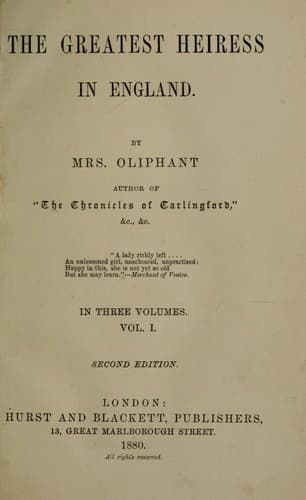
The Greatest Heiress in EnglandOliphant, Mrs. (Margaret)
General
The Greatest Heiress in England
Oliphant, Mrs. (Margaret)
England -- Fiction; Inheritance and succession -- Fiction
“This is what it is to be poor,” Mrs Russell said. “Oh, I ought to thank
you for it, that among other things, I never would have known all the
bitterness of being poor but for this; and yet I never held out my hand
to ask anything,” she cried, beginning to weep. “I never thrust my
poverty on anybody. I did all I could to keep up--a good appearance; and
to hope--” here the sobs burst forth again beyond restraint--“for better
days.”
“What is the matter?” said Bertie pushing open the door. He was
carelessly dressed in an old coat, his hair in disorder, his feet in
slippers, he who had always decorated himself so carefully for Lucy’s
eyes. He did not take the trouble to open the door with his hand, but
pushed it rudely with his person, and gave Lucy a sullen nod and
good-morning. “What are you making such a row about, mother?” he said.
“Oh, Bertie, Miss Trevor has come--to offer me charity!” she cried,
“charity! She sees we are poor, and, because she is rich, she thinks she
can treat me, me! like a beggar in the street, and offer me money, Oh,
Bertie! Bertie! my boy!” the poor woman threw her arm round him, and
began to sob on his shoulder, “what has your poor mother done that she
should be humbled like this?”
“Charity!” he said; then looked at Lucy with an insolent laugh that
brought the color to the girl’s face; “it is, perhaps, conscience
money,” he cried. Then putting his mother away from him “Go and lie
down, mamma, you have had excitement enough this morning. We are not
beggars, whatever Miss Trevor may think.” Bertie’s eyes were red, too;
he was still at the age when tears, though the man is ashamed of them,
are not far from the eyes when trouble comes. “Naturally,” he said, “we
all stand upon what we have got, and money is what you have got, Miss
Trevor. Oh, it is a very good thing, it saves you from many annoyances.
We have not very much of it, but we can do without charity.” His lip
quivered, his heart was sore, and his pride cut to pieces. “Money is not
everything, though, perhaps, _you_ may be excused for thinking so,” he
said. He wanted to retaliate on some one; the smarting of his eyelids,
the quiver which he could not keep from his lips, the wounds of his
pride still bleeding and fresh, all filled him with a kind of blind
fury and desire to make some one else suffer. He would have liked to
tear his Angel of Hope to pieces in the misery of his disappointment.
Was it not her fault?
As for Lucy, she stood like a culprit before the mother and the son,
looking at them with a pathetic protest in her eyes, like that with
which an innocent dumb creature appeals against fate. She was as much
surprised by all this storm of denunciation as a lamb is by the blow
that ends its life. When they were silent, and it was time for her to
speak, she opened her lips and drew a long troubled breath, but she
could say nothing for herself. What was there to say? She was too much
astonished even for indignation.
Public-domain text, read in full here on John Shaqi.
Reviews
Reviews
No reviews yet
Be the first to share your thoughts on this work.
Elsewhere in the archive
Join the Discussion
Join the discussion
Sign in to leave a comment or review.
Sign InorCreate an account