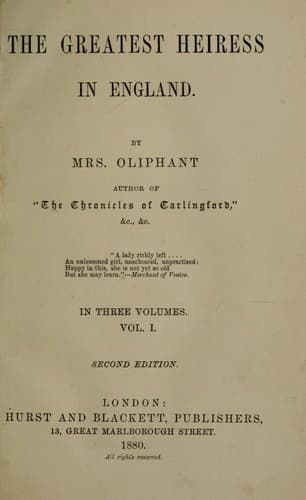
The Greatest Heiress in EnglandOliphant, Mrs. (Margaret)
General
The Greatest Heiress in England
Oliphant, Mrs. (Margaret)
England -- Fiction; Inheritance and succession -- Fiction
(which even in a moment of violent commotion disturbed her orderly soul)
tear a newspaper in several pieces, and throw it into the basket under
the writing-table--a _new_ newspaper, for it was Saturday. What could he
mean? Near Lady Randolph was seated old Lady Betsinda full in the light,
and looking more like a merchant of old clothes than ever; while Mrs.
Berry-Montagu had her usual place in the shadow of the curtains; the two
visitors had the conversation in their hands.
“My dear Mary Randolph,” Lady Betsinda was saying, “you ought to have
taken my advice. Never have anything to do with authors; I say it to
everybody, and to you I am sure if I have said it once I have said it a
hundred times. They are a beggarly race; they don’t print by
subscriptions nowadays, but they do far worse. If they can not get as
much out of you as they want they will make you suffer for it. Have not
I told you? When you’re good to them, they think they pay you a
compliment by accepting it. A great many people think it gives them
importance to have such persons about their house; they think that is
the way to get a _salon_ like the French, but there never was a greater
mistake. Authors, so far as I’ve seen, are the very dullest people
going; if they ever have an idea in their heads they save it up
carefully for their books.”
“What would you have them to do with it, Lady Betty? Waste it upon you
and me? Most likely we should not understand it,” said the other lady,
with her soft little sneer. “Come in, come in, Miss Trevor, and sit and
learn at Lady Betty’s feet.”
Lady Randolph bent toward the speaker with a rapid whisper.
“Not a word to Lucy about it, for heaven’s sake!” she said.
Mrs. Berry-Montagu made no reply; almost all that could be seen of her
was the malicious gleam in her eyes.
“Come and learn wisdom,” she said, “at the feet of Lady Betsinda. When
we have a university like the men, there shall be a chair of social
experience, and she shall be voted into it by acclamation,” Lady
Betsinda was a little deaf, and rarely caught all that was said, but she
made no show of this imperfection, and went on without asking any
questions.
“I have met a great many authors in my day,” she said; “they used to be
more in society in my time. Now it has become a sort of trade, I hear,
like cotton-spinning. Oh, yes, cotton-spinners, my dear, get into
society--when they are rich enough--and so do the people that write, but
not as they used to do. They are commoner now. It seemed so very clever
once to write a book; now, I hear, it’s a great deal more clever not to
write. I don’t give that as _my_ opinion; ask Cecilia Montagu, it is she
who tells me all the new ideas.”
“Have I said so? It is very likely,” said that lady, languidly. “It
repays one for a great deal of ingratitude on the part of the world, to
have a friend who remembers all one says.”
Public-domain text, read in full here on John Shaqi.
Reviews
Reviews
No reviews yet
Be the first to share your thoughts on this work.
Elsewhere in the archive
Join the Discussion
Join the discussion
Sign in to leave a comment or review.
Sign InorCreate an account