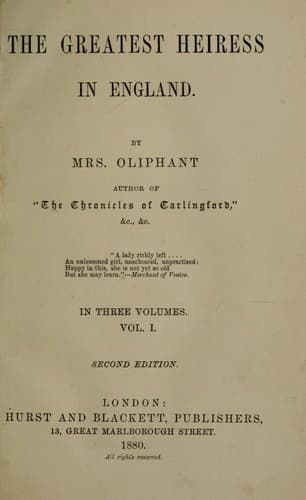
The Greatest Heiress in EnglandOliphant, Mrs. (Margaret)
General
The Greatest Heiress in England
Oliphant, Mrs. (Margaret)
England -- Fiction; Inheritance and succession -- Fiction
The day on which these events occurred was the day of Mr. Frank St.
Clair’s arrival at the White House, where he had come dutifully in
answer to his aunt’s summons, to hear of “something to his advantage.”
To do him justice, he was by no means delighted with the project; but he
was dutiful and needy, and there was nothing for it but to submit. He
went the next morning to pay his respects to the heiress and assume the
charge of his pupil. It was not a long walk from the White House, but
Mr. Frank St. Clair was warm when he arrived, being, according to the
euphemism of the day, “out of training,” and glad to sit down and
contemplate the little fellow who was to be the instrument of his
fortune. Jock, who had resumed his position on the white rug, and lay
there, cool and at his ease, while Lucy dutifully read her history, was
by no means inclined to submit to any examination.
“Come and tell me what you can do, my little man,” Mr. St. Clair said;
“let us see which of us knows the most; we are going to teach each
other--you me, or I you. Come and let’s make out which it is to be.”
Jock raised his head from the rug and looked at his questioner with big
eyes. The inspection did not seem to please him. “I know a lot,” he
said, concisely, and dropped his head; his book was more interesting
than the stranger. It was “Don Quixote,” with pictures, which he had in
his hands; this deeply experienced reader had never encountered the work
with these attractions before.
“I told you, Miss Trevor,” said St. Clair, “he sees through me, he knows
my learning is antiquated. If a man has the misfortune to live before
Madvig, what is he to do? Scholarship is the most progressive of all
sciences; which is curious, considering that it is with dead languages
it has to do.”
Lucy raised her mild eyes with no understanding in them. It was in vain
to speak of dead languages to her. “Though he is so little,” she said,
apologetically, “he has read a great many books. That is what he means;
but he has had no education, Mr. St. Clair, except just a little at
Hampstead. He has done nothing but read books--nonsense books,” said
Lucy severely, thinking to reach the culprit, “that could not teach him
anything or do him any good.”
“Reading books is, on the whole, not a bad kind of education,” said St.
Clair. “I see you pursue that way yourself.”
“Oh--but this is history; it is not in the least amusing; sometimes it
is very hard; I can’t remember it a bit; and sometimes I almost go to
sleep: very different,” said Lucy, pointedly, “from the books that Jock
reads; they make him laugh, they make him so interested that he can’t
bear any one to speak to him. He won’t go to bed, he won’t play for
them. _That_ can not be education at all.”
“Very true,” Mr. St. Clair said. “Medicine must be nasty. Might one
know, my friend, what you are reading now?”
Public-domain text, read in full here on John Shaqi.
Reviews
Reviews
No reviews yet
Be the first to share your thoughts on this work.
Elsewhere in the archive
Join the Discussion
Join the discussion
Sign in to leave a comment or review.
Sign InorCreate an account