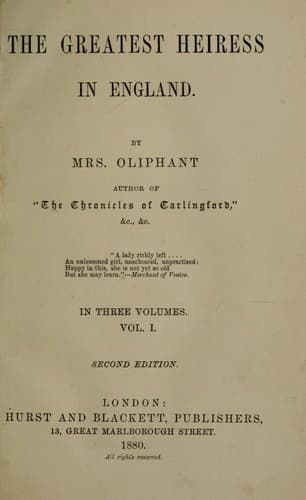
The Greatest Heiress in EnglandOliphant, Mrs. (Margaret)
General
The Greatest Heiress in England
Oliphant, Mrs. (Margaret)
England -- Fiction; Inheritance and succession -- Fiction
Lucy looked at him with great respect, and even a little awe. An
innocent girl has a certain awe of a man so much older than herself, so
much more experienced in every way, who perhaps has had mysterious
wrong-doings in his life as well as other things, more momentous and
terrible than any her imagination has ever realized. The things that St.
Clair might have to be ashamed of loomed large upon her in the darkness
of her ignorance, like gigantic shadows, upon which she looked with pity
and a little horror, yet the same time an awful respect. “Mrs. Stone
told me,” she said, with her serious face, “that you had not been well;
that after all your studies and work you had not been well enough-- I am
very, very sorry. It must have been a great disappointment.”
“That is exactly what it was; it is very sweet to meet with some one who
understands,” St. Clair said; “yes, it is not so much for myself, but
they had all done so much for me, all believed in me so.”
“But, Mr. St. Clair, with rest and taking care, will it not all come
right?”
“They say so,” he said; “but, Miss Trevor, though you don’t know much of
the hardships of life, you will understand that this is exactly what it
is most hard to do. To rest implies means and leisure, and I ought to be
working night and day.”
“I am very, very sorry,” said Lucy; a great many waves of varying
resolution were passing over her mind--what could she do? would it be
most polite to take notice, to receive such a confidence as if it was
nothing to her? or should she be bold and put forth her powers as a
helper, a wrong-redresser? Jock’s story about the windmills had seemed
very great nonsense to his unlettered sister, yet practically she was in
a strait not dissimilar. She put her lance in rest with a very doubtful
and unassured hand; but if they were giants, as they seemed, she, too,
felt, like the great Spaniard, that to pass them by would be cowardly.
She looked at him wistfully, faltering. “You will think it strange of me
to say it,” she said, her serious face gradually crimsoning from chin to
forehead; “but perhaps you know--that I am--not the same as other girls;
if there were anything that I could do--”
St. Clair grew red too with surprise and mortification; what could the
girl mean? he asked himself; but he answered suavely, “I am sure you are
a great deal better and kinder than most girls--or men either, Miss
Trevor. You have the divine gift of sympathy, which always does one
good.”
“I don’t know if it is sympathy, Mr. St. Clair. Papa left me a great
many directions. He said there were some things I was to try to do; and
if it would be good for you to have leisure, and be able to rest for a
year or two--”
St. Clair was reduced to the level of Raymond Rushton by the utter
confusion which these words seemed to bring into the very atmosphere.
Public-domain text, read in full here on John Shaqi.
Reviews
Reviews
No reviews yet
Be the first to share your thoughts on this work.
Elsewhere in the archive
Join the Discussion
Join the discussion
Sign in to leave a comment or review.
Sign InorCreate an account