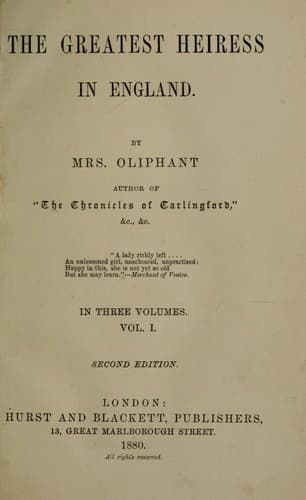
The Greatest Heiress in EnglandOliphant, Mrs. (Margaret)
General
The Greatest Heiress in England
Oliphant, Mrs. (Margaret)
England -- Fiction; Inheritance and succession -- Fiction
“Which is more than you are likely to do on old Fryer’s horses,” St.
Clair said, laughing. But then he got up, feeling that he had made an
end of his young rival. He was bigger, broader, altogether more imposing
than Raymond. He stood up, and expanded his large proportions, feeling
that anybody with half an eye must see the difference--which, perhaps,
on the whole, was an unwise step; for St. Clair was too much developed
for a young man, and the merest suspicion of fatness, is not that a
capital crime in a girl’s eyes? On the whole, when they stood up
together, Raymond’s slim youthfulness carried the day; but there are no
delusions so obstinate as those which concern our own personal
appearance, and it was with a smile of conscious triumph that the larger
young man spread himself out. As for Raymond he too felt outdone, and
withdrew a little from the competition.
“Emmie has got her pony,” he said. “My mother thinks it will do her a
great deal of good to see how you ride, Miss Trevor.”
“Oh, but I never was considered to ride very well,” Lucy said.
“We think down here that whatever you do is done well,” said St. Clair,
taking the very words out of Raymond’s mouth, with this difference, that
Ray would have uttered them seriously, and would have broken down,
whereas _that_ fellow made a joke of it, and carried off the compliment
with a laugh. “We are not much used to accomplished young ladies from
town down here,” St. Clair added; “and whatever you do is a wonder to
us. ‘When you speak we’d have you do so ever; when you sing we’d have
you buy and sell so, so give alms--’”
From this it will be seen that Mr. Frank St. Clair was possessed of some
of the graces of letters. But the young persons on either side of him
opened their eyes. Ray had a suspicion that there was some sort of
play-acting in it; but Lucy was simply amazed that any one should speak
of her singing when she could not sing at all.
“Indeed,” she said, seriously, “I do not know a note. I never had a
voice, and what was the use of having lessons?” which simple answer,
though it made him laugh, entirely disconcerted St. Clair, and reduced
him almost to the level of Raymond, who had now got one hand into his
pocket and felt more comfortable and at his ease. It was thus that Ray
was left master of the field, somewhat to his own surprise, but at the
same time much to his gratification, too.
“I say, what a queer fellow that is,” Raymond said; “we all want to know
about him. If he’s a barrister, as they say, why isn’t he at his
chambers, or on circuit, or something? To be sure it’s the ‘Long’ just
now; but he seems to be always here.”
Public-domain text, read in full here on John Shaqi.
Reviews
Reviews
No reviews yet
Be the first to share your thoughts on this work.
Elsewhere in the archive
Join the Discussion
Join the discussion
Sign in to leave a comment or review.
Sign InorCreate an account