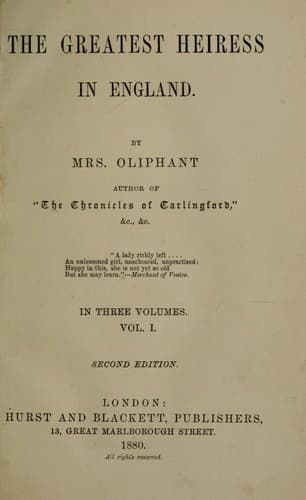
The Greatest Heiress in EnglandOliphant, Mrs. (Margaret)
General
The Greatest Heiress in England
Oliphant, Mrs. (Margaret)
England -- Fiction; Inheritance and succession -- Fiction
“Do you think so? do you really think so? that will make my mind much
more easy about her,” said Philip. As if Katie was a judge! This was the
reflection she herself made: and Katie could scarcely help laughing,
under the shadow of night, at the sudden, importance of her own
judgment. But, after all, however young one may be, one feels that there
is a certain reasonableness in any reliance upon one’s opinion, and she
answered with a gravity that was not quite fictitious, that she was sure
of it, and did all she could to comfort Philip, who, on his part,
exaggerated his anxiety, and carefully refrained from all allusion to
that secret unwillingness to let the great Rainy fortune go to any one
else, which had moved him powerfully during the day. They took leave at
the door of the White House, as they had done before, but not till after
a pause and a lingering talk, always renewed upon some fresh subject by
Philip just as she held out her hand to say good-night. He had held that
hand quite two minutes in his, on the strength of some new and
interesting subject which suddenly occurred to him at the last moment,
when Katie, seized with a little panic, suddenly withdrew it and darted
away. “Good-night,” she said, from the door-step, nodding her head and
waving her hand as before, and once more Philip felt as if a curtain had
dropped, shutting out heaven and earth, when the door opened and shut,
and a gleam of light shone out, then disappeared. Analyze it! he could
not analyze it. He had never been so happy before, nor so sad, nor so
fortunate, nor so desolate; but how he could be so ridiculous as to be
moved in this way, Philip could not tell. He went back along the dark
road, going over every word she had said, and every look she had looked.
Lucy’s window shone all the way before him, the light in it glimmering
out from the dark front of the Terrace. It seemed to Philip that he
could not get rid of Lucy. He felt impatient of her, and of her window,
which seemed to call him, shining as with a signal-light. Its
importunity was such, that he decided at last to cross the road and call
at the door, and ask if she had got home in safety. It was an
unnecessary question, but he was excited and restless, half hating Lucy,
yet unable to overcome the still greater hatred he had, and terror, of
seeing her fall into some one else’s hands. When his voice was heard at
the door, Mrs. Ford rushed out of her parlor with great eagerness.
“Come in, Philip, come in,” she cried; “I heard the carriage stop, but
what have you been doing all this time? I just hoped it might be you;”
then she came close up to him and whispered, “Lucy came in in such good
spirits. She said you had been there; she said you had been very
attentive. If you would like to have a horse to ride to go with them, to
cut out that Raymond Rushton, don’t you hesitate, Philip; tell them to
send the bill to me.”
Public-domain text, read in full here on John Shaqi.
Reviews
Reviews
No reviews yet
Be the first to share your thoughts on this work.
Elsewhere in the archive
Join the Discussion
Join the discussion
Sign in to leave a comment or review.
Sign InorCreate an account