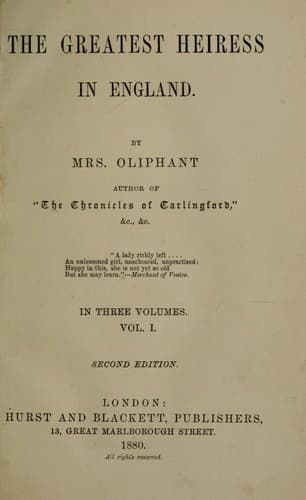
The Greatest Heiress in EnglandOliphant, Mrs. (Margaret)
General
The Greatest Heiress in England
Oliphant, Mrs. (Margaret)
England -- Fiction; Inheritance and succession -- Fiction
“I am her guardian, and I will have nothing to say to any fairy prince,”
Mr. Rushton said. They both gave a glance at their son as they spoke,
who was a good-looking young fellow enough, but not much like a Prince
Charmant. And Lucy smiled and accepted the joke quite calmly, knowing
nothing of any such hero. She heard all his mother’s praise of Raymond
quite unmoved, saying “Indeed,” and “That was very nice;” but without
the faintest gleam of emotion. It was very provoking. Mrs. Rushton had
made up her mind that Lucy was not a girl of much feeling, but yet would
be insensibly moved by habits of association, and by finding one person
always at her elbow wherever she moved. Raymond, in the meantime, had
profited in a way beyond his hopes. He had got a horse, the better to
accompany the heiress on her rides, and his money in his pocket was more
abundant; but when his mother spurred him up to a greater display of
devotion, the young man complained that he had not encouragement.
“Encouragement!” Mrs. Rushton cried; “a girl with no one can tell how
many thousands a year, and you want encouragement!” It seemed to her
preposterous. Oh, that mothers could but do for sons what they are so
lukewarm in doing for themselves! Mrs. Rushton did all that was
possible. She told tales of her boy’s courage and unselfishness, which
were enough to have dazzled any girl, and hinted and insinuated his
bashful love in a hundred delicate ways. But Lucy remained obtuse to
everything. She was not clever nor had she much imagination, and love
had not yet acquired any place in her thoughts.
This was to be the last croquet-party of the season, and all that was
fair and fashionable and eligible in Farafield was gathered on the lawn,
round which the scarlet geraniums were blazing like a gorgeous border to
a great shawl. Rarely had Lucy seen so gay a scene. When she had herself
got through a game, which she did not particularly care for, she was
allowed to place herself in one of the low basket-chairs near the
tea-table, at which Mrs. Rushton was always seated. “Was there ever such
a child?” Mrs. Rushton said; “she prefers to sit with us dowagers rather
than to take her share in the game.”
“And what is still more wonderful,” said an old lady, who perhaps did
not care to hear herself called a dowager, “your son Raymond seems of
the same opinion, though he is a hot croquet-player, as we all know.”
“Oh, Ray; I hope he is too civil to think what he likes himself,” his
mother said, with well-assumed carelessness. But this did not take
anybody in. And all the elder people watched the heiress, as indeed the
younger ones did also in the midst of their game; for though Lucy did
not greatly care for his attendance, there were some who prized Ray, and
to whom his post at her elbow was very distasteful. He was very faithful
to that post on this occasion, for St. Clair had posted himself on
Lucy’s other hand, and Raymond’s energies were quickened by opposition.
Public-domain text, read in full here on John Shaqi.
Reviews
Reviews
No reviews yet
Be the first to share your thoughts on this work.
Elsewhere in the archive
Join the Discussion
Join the discussion
Sign in to leave a comment or review.
Sign InorCreate an account