The Greatest Heiress in EnglandOliphant, Mrs. (Margaret)
General
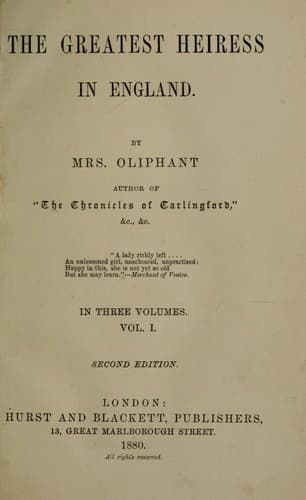
The Greatest Heiress in England
Oliphant, Mrs. (Margaret)
England -- Fiction; Inheritance and succession -- Fiction
“I think so; but do not ask me any more questions,” he said, and he was
treated with the utmost delicacy and consideration. Without another
word, a plate with some of Mrs. Stone’s delicately cooked dish was set
before him, and a large glass of East India sherry poured out, far
better fare than the cold viands and tea prepared for Mrs. Rushton’s
many guests, while the conversation was gently led into another channel.
His feelings could not have been more judiciously studied, for he had
been too much intent upon Lucy to eat much at the previous meal, and
agitation is exhausting. The only further allusion that was made to the
crisis was when Mrs. Stone bade him good-night. She kissed him on the
cheek, and said softly, “I quite approve your action if you think the
occasion is ripe for it, but do not be premature, my dear boy.”
“No, I will not be premature,” he said, smiling upon her. His heart
expanded with a delightful self-confidence. It did not seem to him that
there was any cause to fear.
And as he sat in the little room at the end of the long passage, where
he was permitted to smoke, and watched the floating clouds that rose
from his cigar, the imaginations which rose along with these circling
wreaths were beautiful. He saw within his grasp a something sweeter than
love, more delicious than any kind of dalliance. Wealth! the power of
doing whatever he pleased, stepping at once into a position, he, the
unsuccessful, which would leave all the successful men behind, and
dazzle those who had once passed him by in the race. He was not
disinclined toward Lucy. He felt it was in him indeed to be fond of her,
who could do so much for him. She could open to him the gates of
paradise, she could make him the happiest man in the world. These
hyperboles would be strictly true, far more true than they were in the
majority of the cases in which they were uttered with fullest sincerity.
But nobody could be more sincere than Frank St. Clair in his use of the
well-worn formulas. It was nothing less than blessedness, salvation, an
exemption from ills of life which Lucy had it in her power to confer.
Next morning he went as usual to the Terrace and gave Jock his lesson
with a mind somewhat disturbed. The little fellow with his grammar, the
tranquil figure of the girl over her books, the ordinary aspect of the
room with which he was growing so familiar, had the strangest effect
upon him in the state of excitement in which he found himself. The
monotony of the lesson which had to be made out all the same, word by
word, and the strange suspense and expectation in which he sat amid all
the calmness of the domestic scene, made St. Clair’s head go round. He
did not know how to support it, and it was before his hour was out that
he suddenly interrupted Jock’s repetition with a sudden harsh whisper.
“Run and play,” he said; “that is enough for to-day.”
Public-domain text, read in full here on John Shaqi.
Reviews
Reviews
No reviews yet
Be the first to share your thoughts on this work.
Elsewhere in the archive
Join the Discussion
Join the discussion
Sign in to leave a comment or review.
Sign InorCreate an account