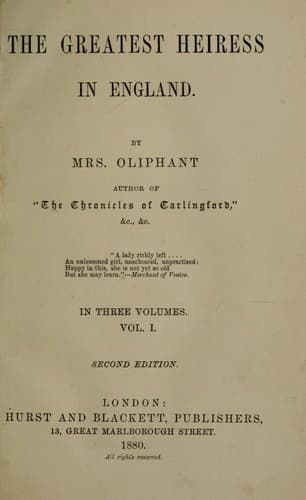
The Greatest Heiress in EnglandOliphant, Mrs. (Margaret)
General
The Greatest Heiress in England
Oliphant, Mrs. (Margaret)
England -- Fiction; Inheritance and succession -- Fiction
“_Have_ you, Mr. St. Clair!” Lucy stammered out in consternation. She
understood him vaguely, and yet she did not understand him. _Have_ him!
not give to him, but take from him. He had put it skillfully, without,
however, being aware that he was doing so, excitement taking the place
of calculation, as it often does. He held out his hands for hers, he
looked at her with eyes full of entreaty, beseeching, imploring. There
was nothing fictitious in their eloquence. He meant as sincerely as ever
lover meant, and the yes or no was to him, as in the case of the most
impassioned wooer, like life or death.
“Yes,” he said, “have me! I am not much of a man, but with you I should
be another creature. You would give me what I have always wanted, an
inspiration, a motive. Since the first time I saw you, my happiness has
been in your hands; for what else do you think I have been staying here?
I have not done all I might have done, but, Lucy, if love had not held
me, do you think I am good for nothing but to be tutor to a child? I
have served for love, like Jacob, for you.”
Lucy gave a low cry at this. She put her hands, not into his, but
together, wringing them with sudden pain.
“Oh,” she said, “why did not you tell me before? Oh, Mr. St. Clair, why
did I not know?”
“Do you think I grudge it?” he said, “not if it had been as long as
Jacob’s. Do you think I regret having done this for you? not if it had
been a life-time; but Lucy, you are too good to keep me in suspense, you
will give me my reward at the end?”
And this time he took her clasped hands into his, drawing her to him.
Lucy’s courage had failed for a moment. Confusion and trouble and
distress had taken away all the strength from her. There was a mist over
her eyes, and her voice seemed to die away in her throat; but at his
touch her girlish shyness came to her aid. A flush of shrinking and
shame came over her. She drew away from him with an instinctive recoil.
“Mr. St. Clair, I don’t know what you want from me. I am very grateful
to you about Jock. I thought it was a great favor; but I did not
know--oh, I am very sorry, very sorry that you should have done anything
that was not good enough for me.”
“I am not sorry,” he said; his heart began to sink, but he looked more
lover-like, more eager than ever. “You do not know how sweet it is to
serve those one loves. Do you remember what Browning says about Dante’s
angel and Raphael’s sonnet?” He was a man of culture himself, and he did
not reflect that Dante, and Raphael, and Browning were all alike out of
Lucy’s way, who stared at him with growing horror, as he pleaded,
feeling that he must be citing spectators of his sacrifices for her, who
would blame her, and say she used him badly. “This is my sonnet and my
picture,” he added; “‘Once, and only once, and for one only.’ Lucy!
believe me, I should never have said anything about it, save to prove my
dear love.”
Public-domain text, read in full here on John Shaqi.
Reviews
Reviews
No reviews yet
Be the first to share your thoughts on this work.
Elsewhere in the archive
Join the Discussion
Join the discussion
Sign in to leave a comment or review.
Sign InorCreate an account