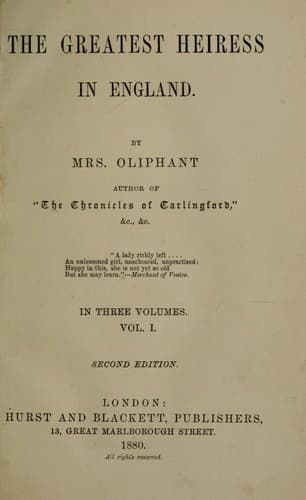
The Greatest Heiress in EnglandOliphant, Mrs. (Margaret)
General
The Greatest Heiress in England
Oliphant, Mrs. (Margaret)
England -- Fiction; Inheritance and succession -- Fiction
“That is very true; and it was very dull. We don’t bring up our children
like that nowadays,” said Mrs. Rushton, with that ironical superiority
which the mother of a family always feels herself justified in
displaying to a childless contemporary. Mrs. Ford had no children to get
the advantage of the new rule. “And,” she added, “one feels for a dear
child like Lucy, who has no mother, that one is doubly bound to do one’s
best for her. How poor dear Mrs. Trevor would have watched over her had
she been spared! a motherless girl has a thousand claims. And, Lucy,”
continued her indulgent friend, “this is Ray’s party. It is he that is
to manage it all; he took it into his head that you would like to see
the Abbey again.”
“Oh, yes,” said Lucy, surprised that they should show so much thought
for her, but quite ready to be pleased and grateful too.
“He and his sister will come and fetch you at two o’clock,” she
continued; “it will be quite hurriedly got up, what I call an
impromptu--but all the better for that. There will be just our own set.
Mrs. Stone of course it would be useless to ask, now that school has
begun again; but if there is any friend whom you would like to have--”
It was as if in direct answer to this half-question that at that moment
the door opened and Katie Russell, all smiles and pleasure, came in.
“Lucy,” she cried, “Bertie has come, as I told you; he wants so much to
see you; may I bring him in? Oh, I beg your pardon, Mrs. Ford, I did not
see that you were here.”
“Don’t mention it,” said Mrs. Ford, grimly; “most folks do the same.”
“Is it your brother, the author?” said Mrs. Rushton, excited. She was so
far out of the world, and so little acquainted with its ways, that she
felt, and thought it the right thing to show that she felt, an interest
in a real living novelist. “Lucy, we must have him come to the picnic,”
she cried.
But she was not so enthusiastic when Bertie appeared. His success had
made a great difference in Bertie’s outward man; he was no longer the
slipshod youth of Hampstead, by turns humble and arrogant, full of
boyish assurance and equally boyish timidity. Even in that condition he
had been a handsome young fellow, with an air of breeding which must
have come from some remote ancestor, as there was no nearer way by which
he could have acquired it. When he walked into the room now, it was as
if a young prince had suddenly appeared among these commonplace people.
It was not his dress, Mrs. Rushton soon decided, for Raymond was as well
dressed as he--nor was it his good looks, though it was not possible to
deny them; it was--more galling still--_something_ which was neither
dress nor looks, but which he had, and, alas! Raymond had not. Mrs.
Rushton gazed at him open-eyed, while he came in smiling and gracious,
shaking hands with cordial grace.
Public-domain text, read in full here on John Shaqi.
Reviews
Reviews
No reviews yet
Be the first to share your thoughts on this work.
Elsewhere in the archive
Join the Discussion
Join the discussion
Sign in to leave a comment or review.
Sign InorCreate an account