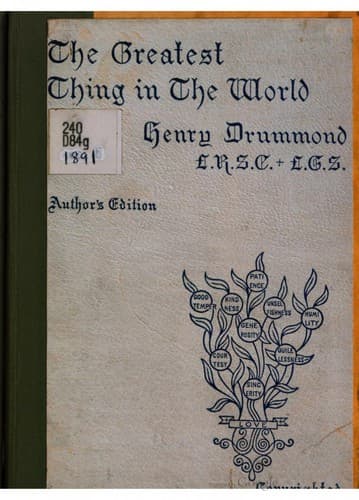
The Greatest Thing In the World and Other AddressesDrummond, Henry
ReligionComparative
The Greatest Thing In the World and Other Addresses
Drummond, Henry
Christian life; Christianity; Love -- Religious aspects
on which this formula is based. One of the aptest descriptions of a
human being is that he is a mirror. As we sat at table to-night the
world in which each of us lived and moved throughout this day was
focused in the room. What we saw when we looked at one another was not
one another, but one another's world. We were an arrangement of
mirrors. The scenes we saw were all reproduced; the people we met
walked to and fro; they spoke, they bowed, they passed us by, did
everything over again as if it had been real. When we talked, we were
but looking at our own mirror and describing what flitted across it;
our listening was not hearing, but seeing--we but looked on our
neighbor's mirror.
All human intercourse is a seeing of reflections. I meet a stranger in
a railway carriage. The cadence of his first words tells me he is
English and comes from Yorkshire. Without knowing it he has reflected
his birthplace, his parents, and the long history of their race. Even
physiologically he is a mirror. His second sentence records that he is
a politician, and a faint inflection in the way he pronounces _The
Times_ reveals his party. In his next remarks I see reflected a whole
world of experiences. The books he has read, the people he has met,
the companions he keeps, the influences that have played upon him and
made him the man he is--these are all registered there by a pen which
lets nothing pass, and whose writing can
NEVER BE BLOTTED OUT.
What I am reading in him meantime he also is reading in me; and before
the journey is over we could half write each other's lives. Whether we
like it or not, we live in glass houses. The mind, the memory, the
soul, is simply a vast chamber panelled with looking-glass. And upon
this miraculous arrangement and endowment depends the capacity of
mortal souls to "reflect the character of the Lord."
(2). But this is not all. If all these varied reflections from our
so-called secret life are patent to the world, how close the writing,
complete the record within the soul itself! For the influences we meet
are not simply held for a moment on the polished surface and thrown
off again into space. Each is retained where first it fell, and stored
up in the soul forever.
THIS LAW OF ASSIMILATION
is the second, and by far the most impressive truth which underlies
the formula of sanctification--the truth that men are not only
mirrors, but that these mirrors, so far from being mere reflectors of
the fleeting things they see, transfer into their own inmost
substance, and hold in permanent preservation the things that they
reflect.
Public-domain text, read in full here on John Shaqi.
Reviews
Reviews
No reviews yet
Be the first to share your thoughts on this work.
Join the Discussion
Join the discussion
Sign in to leave a comment or review.
Sign InorCreate an account