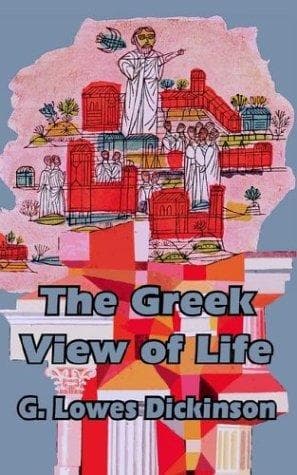
The Greek View of LifeDickinson, G. Lowes (Goldsworthy Lowes)
Religion
The Greek View of Life
Dickinson, G. Lowes (Goldsworthy Lowes)
Greece -- Civilization
Only in Ancient Athens, perhaps, could such a character and such
conditions have met. The sociable out-door city life; the meeting places
in the open air, and especially the gymnasia, frequented by young and
old not more for exercise of the body than for recreation of the mind;
the nimble and versatile Athenian wits trained to preternatural
acuteness by the debates of the law courts and the Assembly; all this
was exactly the environment fitted to develop and sustain a genius at
once so subtle and so humane as that of Socrates. It is the concrete
presentation of this city-life that lends so peculiar a charm to the
dialogues of Plato. The spirit of metaphysics puts on the human form;
and Dialectic walks the streets and contends in the palaestra. It would
be impossible to convey by citation the cumulative effect of this
constant reference in Plato to a human background; but a single excerpt
may perhaps help us to realise the conditions under which Socrates lived
and worked. Here, then, is a description of the scene in one of those
gymnasia in which he was wont to hold his conversations:
"Upon entering we found that the boys had just been sacrificing; and
this part of the festival was nearly at an end. They were all in white
array, and games at dice were going on among them. Most of them were in
the outer court amusing themselves; but some were in a corner of the
Apodyterium playing at odd and even with a number of dice, which they
took out of little wicker baskets. There was also a circle of lookers-
on, one of whom was Lysis. He was standing among the other boys and
youths, having a crown upon his head, like a fair vision, and not less
worthy of praise for his goodness than for his beauty. We left them, and
went over to the opposite side of the room, where, finding a quiet
place, we sat down; and then we began to talk. This attracted Lysis, who
was constantly turning round to look at us--he was evidently wanting to
come to us. For a time he hesitated and had not the courage to come
alone; but first of all, his friend Menexenus came in out of the court
in the interval of his play, and when he saw Ctesippus and myself, came
and sat by us; and then Lysis, seeing him, followed, and sat down with
him, and the other boys joined.
"I turned to Menexenus, and said: 'Son of Demophon, which of you two
youths is the elder?'
"'That is a matter of dispute between us,' he said.
"'And which is the nobler? Is that a matter of dispute too?'
"'Yes, certainly.'
"'And another disputed point is, which is the fairer?'
"The two boys laughed.
"'I shall not ask which is the richer,' I said; 'for you two are
friends, are you not?'
"'Certainly,' they replied.
"'And friends have all things in common, so that one of you can be no
richer than the other, if you say truly that you are friends.'
Public-domain text, read in full here on John Shaqi.
Reviews
Reviews
No reviews yet
Be the first to share your thoughts on this work.
Elsewhere in the archive
Join the Discussion
Join the discussion
Sign in to leave a comment or review.
Sign InorCreate an account