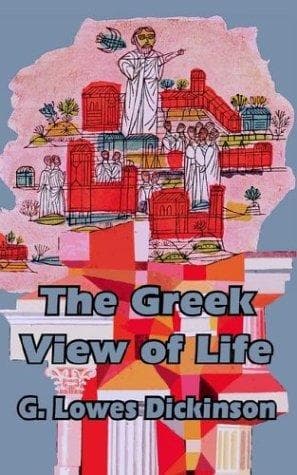
The Greek View of LifeDickinson, G. Lowes (Goldsworthy Lowes)
Religion
The Greek View of Life
Dickinson, G. Lowes (Goldsworthy Lowes)
Greece -- Civilization
"And now, taking my leave of you, I will rehearse a tale of love which I
heard from Diotima of Mantineia, a woman wise in this and in many other
kinds of knowledge. She was my instructress in the art of love, and I
shall repeat to you what she said to me: 'On the birthday of Aphrodite
there was a feast of the gods, at which the god Poros or Plenty, who is
the son of Metis or Discretion, was one of the guests. When the feast
was over, Penia or Poverty, as the manner is on such occasions, came
about the doors to beg. Now Plenty, who was the worse for nectar (there
was no wine in those days), went into the garden of Zeus and fell into a
heavy sleep; and Poverty considering her own straitened circumstances,
plotted to have a child by him, and accordingly she lay down at his side
and conceived Love, who partly because he is naturally a lover of the
beautiful, and because Aphrodite is herself beautiful, and also because
he was born on her birthday, is her follower and attendant. And as his
parentage is, so also are his fortunes. In the first place he is always
poor, and anything but tender and fair, as the many imagine him; and he
is rough and squalid, and has no shoes, nor a house to dwell in; on the
bare earth exposed he lies under the open heaven, in the streets, or at
the doors of houses, taking his rest; and like his mother he is always
in distress. Like his father too, whom he also partly resembles, he is
always plotting against the fair and good; he is bold, enterprising,
strong, a mighty hunter, always weaving some intrigue or other, keen in
the pursuit of wisdom, fertile in resources; a philosopher at all times,
terrible as an enchanter, sorcerer, sophist. He is by nature neither
mortal nor immortal, but alive and flourishing at one moment when he is
in plenty, and dead at another moment, and again alive by reason of his
father's nature. But that which is always flowing in is always flowing
out, and so he is never in want and never in wealth; and, further, he is
in a mean between ignorance and knowledge. The truth of the matter is
this: No god is a philosopher or seeker after wisdom, neither do the
ignorant seek after wisdom. For herein is the evil of ignorance, that he
who is neither good nor wise is nevertheless satisfied with himself: he
has no desire for that of which he feels no want.' 'But who then,
Diotima,' I said, 'are the lovers of wisdom, if they are neither the
wise nor the foolish?' 'A child may answer that question,' she replied;
'they are those who are in a mean between the two; Love is one of them.
For wisdom is a most beautiful thing, and Love is of the beautiful; and
therefore Love is also a philosopher or lover of wisdom, and being a
lover of wisdom is in a mean between the wise and the ignorant. And of
this too his birth is the cause; for his father is wealthy and wise, and
his mother poor and foolish. Such, my dear Socrates, is the nature of
the spirit Love.'
Public-domain text, read in full here on John Shaqi.
Reviews
Reviews
No reviews yet
Be the first to share your thoughts on this work.
Elsewhere in the archive
Join the Discussion
Join the discussion
Sign in to leave a comment or review.
Sign InorCreate an account