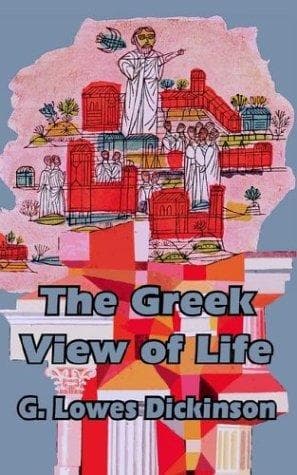
The Greek View of LifeDickinson, G. Lowes (Goldsworthy Lowes)
Religion
The Greek View of Life
Dickinson, G. Lowes (Goldsworthy Lowes)
Greece -- Civilization
To say this, is not, of course, to say that the Greek conception of art
was didactic; for the word didactic, when applied to art, has usually
the implication that the excellence of the moral is the only point to be
considered, and that if that is good the work itself must be good. This
idea does indeed occur in Greek thought--we find it, for example,
paradoxically enough, in so great an artist as Plato--but if it had been
the one which really determined their production, there would have been
no occasion to write this chapter, for there would have been no Greek
art to write about. The truer account of the impulse that urged them to
create is that given also by Plato in an earlier and more impassioned
work, in which he describes it as a "madness of those who are possessed
by the Muses; which enters into a delicate and virgin soul, and there
inspiring frenzy, awakens lyrical and all other numbers; with these
adorning the myriad actions of ancient heroes for the instruction of
posterity. But he who having no touch of the Muses' madness in his soul,
comes to the door and thinks that he will get into the temple by the
help of art--he, I say, and his poetry are not admitted; the sane man is
nowhere at all when he enters into rivalry with the madman." [Footnote:
Plato, Phaedrus, 245a.--Translated by Jowett.]
The presupposition, in fact, of all that can be said about the Greek
view of art, is that primarily and to begin with they were, by nature,
artists. Judged simply by the aesthetic standard, without any
consideration of subject matter at all, or any reference to
intellectual or ethical ideals, they created works of art more purely
beautiful than those of any other age or people. Their mere household
crockery, their common pots and pans, are cast in shapes so exquisitely
graceful, and painted in designs so admirably drawn and composed, that
any one of them has a higher artistic value than the whole contents of
the Royal Academy; and the little clay figures they used as we do china
ornaments put to shame the most ambitious efforts of modern sculpture.
Who, for example, would not rather look at a Tanagra statuette than at
the equestrian statue of the Duke of Wellington?
The Greeks, in fact, quite apart from any theories they may have held,
were artists through and through; and that is a fact we must carry with
us through the whole of our discussion.
Section 2. Identification of the Aesthetic and Ethical Points of View.
Public-domain text, read in full here on John Shaqi.
Reviews
Reviews
No reviews yet
Be the first to share your thoughts on this work.
Elsewhere in the archive
Join the Discussion
Join the discussion
Sign in to leave a comment or review.
Sign InorCreate an account