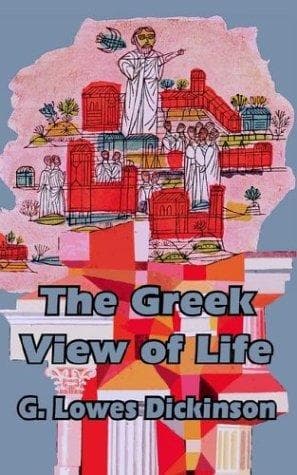
The Greek View of LifeDickinson, G. Lowes (Goldsworthy Lowes)
Religion
The Greek View of Life
Dickinson, G. Lowes (Goldsworthy Lowes)
Greece -- Civilization
Let us take, for example, the statue of Zeus at Olympia, the most famous
of the works of Pheidias. This colossal figure of ivory and gold was
doubtless, according to all the testimony we possess, from a merely
aesthetic point of view, among the most consummate creations of human
genius. But what was the main aim of the artist who made it? what the
main effect on the spectator? The artist had designed and the spectator
seemed to behold a concrete image of that Homeric Zeus who was the
centre of his religious consciousness--the Zeus who "nodded his dark
brow, and the ambrosial locks waved from the King's immortal head, and
he made great Olympus quake." [Footnote: Iliad i. 528.--Translated by
Lang, Leaf and Myers.] "Those who approach the temple," says Lucian, "do
not conceive that they see ivory from the Indies or gold from the mines
of Thrace; no, but the very son of Kronos and Rhea, transported by
Pheidias to earth and set to watch over the lonely plain of Pisa." "He
was," says Dion Chrysostom, "the type of that unattained ideal, Hellas
come to unity with herself; in expression at once mild and awful, as
befits the giver of life and all good gifts, the common father, saviour
and guardian of men; dignified as a king, tender as a father, awful as
giver of laws, kind as protector of suppliants and friends, simple and
great as giver of increase and wealth; revealing, in a word, in form and
countenance, the whole array of gifts and qualities proper to his
supreme divinity."
The description is characteristic of the whole aim of Greek sculpture,--
the representation not only of beauty, but of character, not only of
character but of character idealised. The statues of the various gods
derive their distinguishing individuality not merely from their
association with conventional symbols, but from a concrete reproduction,
in features, expression, drapery, pose, of the ethical and intellectual
qualities for which they stand. An Apollo differs in type from a Zeus,
an Athene from a Demeter; and in every case the artist works from an
intellectual conception, bent not simply on a graceful harmony of lines,
but on the representation of a character at once definite and ideal.
Public-domain text, read in full here on John Shaqi.
Reviews
Reviews
No reviews yet
Be the first to share your thoughts on this work.
Elsewhere in the archive
Join the Discussion
Join the discussion
Sign in to leave a comment or review.
Sign InorCreate an account