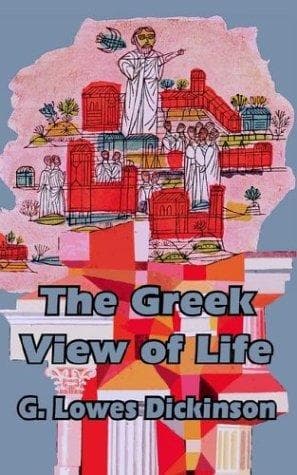
The Greek View of LifeDickinson, G. Lowes (Goldsworthy Lowes)
Religion
The Greek View of Life
Dickinson, G. Lowes (Goldsworthy Lowes)
Greece -- Civilization
If now, as we have seen, in the plastic arts, and in an art which
appears to us so pure as music, the Greeks perceived and valued, along
with the immediate pleasure of beauty, a definite ethical character and
bent, much more was this the case with poetry, whose material is
conceptions and ideas. The works of the poets, and especially of Homer,
were in fact to the Greeks all that moral treatises are to us; or
rather, instead of learning their lessons in abstract terms, they learnt
them out of the concrete representation of life. Poetry was the basis of
their education, the guide and commentary of their practice, the
inspiration of their speculative thought. If they have a proposition to
advance, they must back it by a citation: if they have a counsel to
offer, they must prop it with a verse. Not only for delight, but for
inspiration, warning and example, they were steeped from childhood
onwards in an ocean of melodious discourse; their national epics were to
them what the Bible was to the Puritans; and for every conjunction of
fortune, for every issue of home or state, they found therein a text to
prompt or reinforce their decision. Of this importance of poetry in the
life of ancient Greece, and generally of the importance of music and
art, the following passage from Plato is a striking illustration: "When
the boy has learned his letters and is beginning to understand what is
written, as before he understood only what was spoken, they put into his
hands the works of great poets, which he reads at school; in these are
contained many admonitions, and many tales, and praises, and encomia of
ancient famous men, which he is required to learn by heart, in order
that he may imitate or emulate them and desire to become like them. Then
again the teachers of the lyre take similar care that their young
disciple is temperate and gets into no mischief; and when they have
taught him the use of the lyre, they introduce him to the poems of other
excellent poets, who are the lyric poets; and these they set to music
and make their harmonies and rhythms quite familiar to the children's
souls, in order that they may learn to be more gentle and harmonious and
rhythmical, and so more fitted for speech and action; for the life of
man in every part has need of harmony and rhythm," [Footnote: Plato
Prot. 325c.--Translated by Jowett.]
Public-domain text, read in full here on John Shaqi.
Reviews
Reviews
No reviews yet
Be the first to share your thoughts on this work.
Elsewhere in the archive
Join the Discussion
Join the discussion
Sign in to leave a comment or review.
Sign InorCreate an account