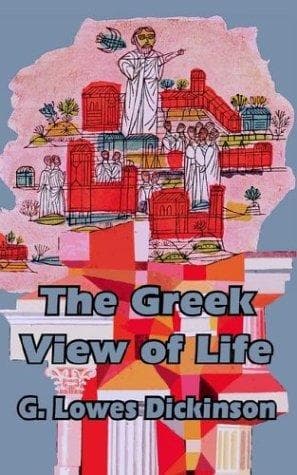
The Greek View of LifeDickinson, G. Lowes (Goldsworthy Lowes)
Religion
The Greek View of Life
Dickinson, G. Lowes (Goldsworthy Lowes)
Greece -- Civilization
Bearing this in mind we may now proceed to recapitulate our conclusions
as to what that view was. And, first, let us take the side of
speculation. Here we are concerned not with the formal systems of Greek
thought, but with that half-unconscious working of imagination as much
as of mind whose expression was their popular religion. Of this
religion, as we saw, the essential feature was that belief in
anthropomorphic gods, by virtue of which a reconciliation was effected
between man and the powers whether of nature or of his own soul. Behind
phenomena, physical or psychic, beings were conceived of like nature
with man, beings, therefore, whose actions he could interpret and whose
motives he could comprehend. For his imagination, if not for his
intellect, a harmony was thus induced between himself and the world that
was not he. A harmony! and in this word we have the key to the dominant
idea of the Greek civilisation.
For, turning now to the practical side, we find the same impulse to
reconcile divergent elements. That antithesis of soul and body which was
emphasised in the mediaeval view of life and dominates still our current
ethical conceptions, does not appear in the normal consciousness of the
Greeks. Their ideal for the individual life included the perfection of
the body; beauty no less than goodness was the object of their quest,
and they believed that the one implied the other. But since the
perfection of the body required the co-operation of external aids, they
made these also essential to their ideal. Not merely virtue of the soul,
not merely health and beauty of the body, but noble birth, sufficient
wealth and a good name among men, were included in their conception of
the desirable life. Harmony, in a word, was the end they pursued,
harmony of the soul with the body and of the body with its environment;
and it is this that distinguishes their ethical ideal from that which in
later times has insisted on the fundamental antagonism of the inner to
the outer life, and made the perfection of the spirit depend on the
mortification of the flesh.
Public-domain text, read in full here on John Shaqi.
Reviews
Reviews
No reviews yet
Be the first to share your thoughts on this work.
Elsewhere in the archive
Join the Discussion
Join the discussion
Sign in to leave a comment or review.
Sign InorCreate an account