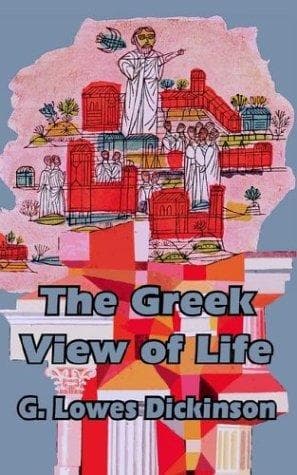
The Greek View of LifeDickinson, G. Lowes (Goldsworthy Lowes)
Religion
The Greek View of Life
Dickinson, G. Lowes (Goldsworthy Lowes)
Greece -- Civilization
The source of this divergence of view must be sought in the whole
circumstances and character of the Greek states. Founded in the
beginning by conquest, many of them still retained, in their internal
structure, the marks of their violent origin. The citizens, for example,
of Sparta and of Crete, were practically military garrisons, settled in
the midst of a hostile population. These were extreme cases; and
elsewhere, no doubt, the distinction between the conquerors and the
conquered had disappeared. Still, it had sufficed to mould the
conception and ideal of the citizen as a member of a privileged and
superior class, whose whole energies were devoted to maintaining, by
council and war, not only the prosperity, but the very existence of the
state. The original citizen, moreover, would be an owner of land, which
would be tilled for him by a subject class. Productive labour would be
stamped, from the outset, with the stigma of inferiority; commerce would
grow up, if at all, outside the limits of the landed aristocracy, and
would have a struggle to win for itself any degree of social and
political recognition. Such were the conditions that produced the Greek
conception of the citizen. In some states, such as Sparta, they
continued practically unchanged throughout the best period of Greek
history; in others, such as Athens, they were modified by the growth of
a commercial population, and where that was the case the conception of
the citizen was modified too, and the whole polity assumed a democratic
character. Yet never, as we have seen, even in the most democratic
states, was the modern conception of equality admitted. For, in the
first place, the institution of slavery persisted, to stamp the mass of
producers as an inferior caste; and in the second place, trade, even in
the states where it was most developed, hardly attained a preponderating
influence. The ancient state was and remained primarily military. The
great industrial questions which agitate modern states either did not
exist at all in Greece, or assumed so simple a form that they did not
rise to the surface of political life. [Footnote: There was, of course,
the general opposition between rich and poor (see below). But not those
infinitely complex relations which are the problems of modern
statesmanship.] How curious it is, for example, from the modern point of
view, to find Plato, a citizen of the most important trading centre of
Greece, dismissing in the following brief sentence the whole commercial
legislation of his ideal state:
Public-domain text, read in full here on John Shaqi.
Reviews
Reviews
No reviews yet
Be the first to share your thoughts on this work.
Elsewhere in the archive
Join the Discussion
Join the discussion
Sign in to leave a comment or review.
Sign InorCreate an account