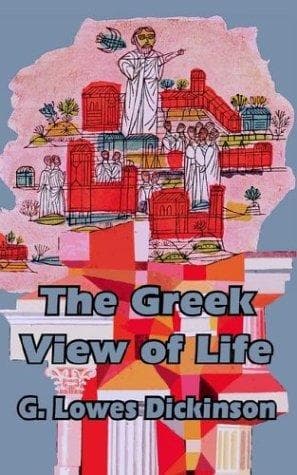
The Greek View of LifeDickinson, G. Lowes (Goldsworthy Lowes)
Religion
The Greek View of Life
Dickinson, G. Lowes (Goldsworthy Lowes)
Greece -- Civilization
the beginning of his "Politics" he distinguishes two kinds of money-
making, one natural, that which is pursued for the sake of a livelihood,
the other unnatural, that which is pursued for the sake of accumulation.
"The motive of this latter," he says, "is a desire for life instead of
for good life"; and its most hateful method is that of usury, the
unnatural breeding of money out of money. And though he rejects as
impracticable the compulsory communism of Plato's "Republic", yet he
urges as the ideal solution that property, while owned by individuals,
should be held as in trust for the common good; and puts before the
legislator the problem: "so to dispose the higher natures that they are
unwilling, and the lower that they are unable to aggrandise themselves."
[Footnote: Aristotle, Pol. ii. 7. 1267 b 6.--Translation by Welldon.]
Such views as these, it may be noted, interesting though they be, as
illustrating how keenly the thinkers of ancient Greece had realised the
drawbacks of private property, have but the slightest bearing on the
conditions of our own time. The complexity and extent of modern industry
have given rise to quite new problems, and quite new schemes for their
solution; and especially have forced into prominence the point of view
of the producers themselves. To Greek thinkers it was natural to
approach the question of property from the side of the governing class
or of the state as a whole. The communism of Plato, for example, applied
only to the "guardians" and soldiers, and not to the productive class on
whom they depended; and so completely was he pre-occupied with the
former to the exclusion of the latter, that he dismisses in a single
sentence, as unworthy the legislator's detailed attention, the whole
apparatus of labour and exchange. To regard the "working-class" as the
most important section of the community, to substitute for the moral or
political the economic standpoint, and to conceive society merely as a
machine for the production and distribution of wealth, would have been
impossible to an ancient Greek. Partly by the simplicity of the economic
side of the society with which he was acquainted, partly by the habit of
regarding the labouring class as a mere means to the maintenance of the
rest, he was led, even when he had to deal with the problem of poverty
and wealth, to regard it rather from the point of view of the stability
and efficiency of the state, than from that of the welfare of the
producers themselves. The modern attitude is radically different; a
revolution has been effected both in the conditions of industry and in
the way in which they are regarded; and the practice and the speculation
of the Greek city-states have for us an interest which, great as it is,
is philosophic rather than practical.
Section 9. Sparta.
Public-domain text, read in full here on John Shaqi.
Reviews
Reviews
No reviews yet
Be the first to share your thoughts on this work.
Elsewhere in the archive
Join the Discussion
Join the discussion
Sign in to leave a comment or review.
Sign InorCreate an account