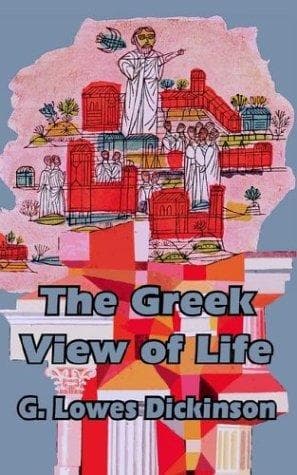
The Greek View of LifeDickinson, G. Lowes (Goldsworthy Lowes)
Religion
The Greek View of Life
Dickinson, G. Lowes (Goldsworthy Lowes)
Greece -- Civilization
"You have never considered," they say to the Lacedaemonians, "what
manner of men are these Athenians with whom you will have to fight, and
how utterly unlike yourselves. They are revolutionary, equally quick in
the conception and in the execution of every new plan; while you are
conservative--careful only to keep what you have, originating nothing,
and not acting even when action is most necessary. They are bold beyond
their strength; they run risks which prudence would condemn; and in the
midst of misfortunes they are full of hope. Whereas it is your nature,
though strong, to act feebly; when your plans are most prudent, to
distrust them; and when calamities come upon you, to think that you will
never be delivered from them. They are impetuous, and you are dilatory;
they are always abroad, and you are always at home. For they hope to
gain something by leaving their homes; but you are afraid that any new
enterprise may imperil what you have already. When conquerors, they
pursue their victory to the utmost; when defeated, they fall back the
least. Their bodies they devote to their country as though they belonged
to other men; their true self is their mind, which is most truly their
own when employed in her service. When they do not carry out an
intention which they have formed, they seem to have sustained a personal
bereavement; when an enterprise succeeds, they have gained a mere
instalment of what is to come; but if they fail, they at once conceive
new hopes and so fill up the void.
"With them alone to hope is to have, for they lose not a moment in the
execution of an idea. This is the lifelong task, full of danger and
toil, which they are always imposing upon themselves. None enjoy their
good things less, because they are always seeking for more. To do their
duty is their only holiday, and they deem the quiet of inaction to be as
disagreeable as the most tiresome business. If a man should say of them,
in a word, that they were born neither to have peace themselves nor to
allow peace to other men, he would simply speak the truth." [Footnote:
Thuc. i. 70.--Translated by Jowett.]
The qualities here set forth by Thucydides as characteristic of the
Athenians, were partly the cause and partly the effect of their
political constitution. The history of Athens, indeed, is the very
antithesis to that of Sparta. In place of a type fixed at a stroke and
enduring for centuries, she presents a series of transitions through the
whole range of polities, to end at last in a democracy so extreme that
it refuses to be included within the limits of the general formula of
the Greek state.
Public-domain text, read in full here on John Shaqi.
Reviews
Reviews
No reviews yet
Be the first to share your thoughts on this work.
Elsewhere in the archive
Join the Discussion
Join the discussion
Sign in to leave a comment or review.
Sign InorCreate an account