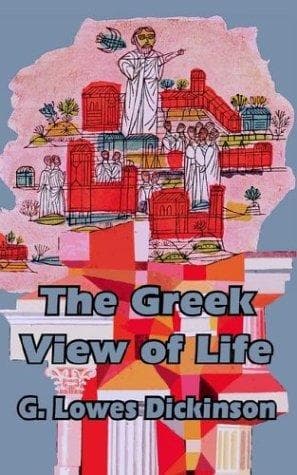
The Greek View of LifeDickinson, G. Lowes (Goldsworthy Lowes)
Religion
The Greek View of Life
Dickinson, G. Lowes (Goldsworthy Lowes)
Greece -- Civilization
Thus, in place of a series of hard and fast rules, a rigid and
uncompromising distinction of acts and affections into good and bad, the
former to be absolutely chosen and the latter absolutely eschewed,
Aristotle presents us with the general type of a subtle and shifting
problem, the solution of which must be worked out afresh by each
individual in each particular case. Conduct to him is a free and living
creature, and not a machine controlled by fixed laws. Every life is a
work of art shaped by the man who lives it; according to the faculty of
the artist will be the quality of his work, and no general rules can
supply the place of his own direct perception at every turn. The Good is
the right proportion, the right manner and occasion; the Bad is all that
varies from this "right." But the elements of human nature in themselves
are neither good nor bad; they are merely the raw material out of which
the one or the other may be shaped.
The idea thus formulated by Aristotle is typically Greek. In another
form it is the basis of the ethical philosophy of Plato, who habitually
regards virtue as a kind of "order." "The virtue of each thing," he
says, "whether body or soul, instrument or creature, when given to them
in the best way comes to them not by chance but as the result of the
order and truth and art which are imparted to them." [Footnote: Plato,
Gorgias, 506 d.--Translated by Jowett] And the conception here
indicated, is worked out in detail in his Republic. There, after
distinguishing in the soul three principles or powers, reason, passion,
and desire, he defines justice as the maintenance among them of their
proper mutual relation, each moving in its own place and doing its
appropriate work as is, or should be, the case with the different
classes in a state.
"The just man will not permit the several principles within him to do
any work but their own, nor allow the distinct classes in his soul to
interfere with each other, but will really set his house in order; and
having gained the mastery over himself, will so regulate his own
character as to be on good terms with himself, and to set those three
principles in tune together, as if they were verily three chords of a
harmony, a higher and a lower and a middle, and whatever may lie between
these; and after he has bound all these together, and reduced the many
elements of his nature to a real unity, as a temperate and duly
harmonized man, he will then at length proceed to do whatever he may
have to do." [Footnote: Plato, Rep. IV. 443.--Translation by Davies and
Vaughan.]
Public-domain text, read in full here on John Shaqi.
Reviews
Reviews
No reviews yet
Be the first to share your thoughts on this work.
Elsewhere in the archive
Join the Discussion
Join the discussion
Sign in to leave a comment or review.
Sign InorCreate an account