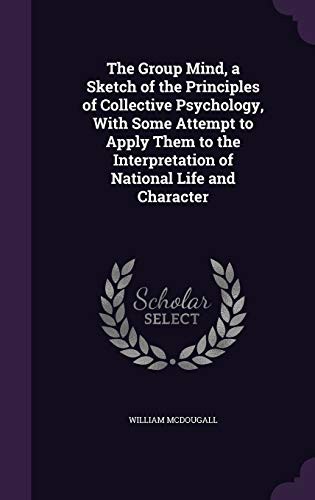
The Group Mind: A Sketch of the Principles of Collective Psychology: With Some Attempt to Apply Them to the Interpretation of National Life and CharacterMcDougall, William
Science
The Group Mind: A Sketch of the Principles of Collective Psychology: With Some Attempt to Apply Them to the Interpretation of National Life and Character
McDougall, William
Ethnopsychology; National characteristics; Social psychology
We must recognise not only the selection, through survival in the
struggle for existence, of new mental qualities arising as spontaneous
variations of individual mental structure. This, which is the only, or
almost the only, process at work in the mental evolution of animals, is
immensely complicated and overshadowed in importance by two processes.
The first is the accumulation of knowledge and morality in traditional
forms. The traditional accumulation, which so far outweighs the mental
equipment possible to any individual isolated from an old society, not
only constitutes in itself a most important evolutionary product, but it
modifies profoundly the conditions of evolution of the individual innate
qualities of mind; for example, the greater and more valuable the stock
of traditional knowledge and morality becomes, the more does fitness to
survive consist in the capacity to assimilate this knowledge and to
conform to these higher moral precepts, the less does it consist in the
purely individualistic qualities, such as quickness of eye and ear,
fleetness of foot, or strength and skill of hand. Secondly, the
processes of natural selection are complicated by the social evolution,
which tends progressively to abolish the struggle for existence between
individuals, and to replace it by a struggle between groups; in which
struggle success is determined not only by the qualities of individuals,
but also very largely by the social organisation and by the traditional
knowledge and morality of the groups.
Each variety of the human species, each race considered as a succession
of individuals having certain innate mental qualities, has been evolved,
then, not merely under the influence of the physical environment, like
the animal species, but also and to an ever increasing extent under the
influence of the social environment. The social environment we regard as
consisting of two parts; namely, the social organisation and the body of
social tradition; for these, though interdependent and constantly
interacting, may yet with advantage be kept apart in thought. We must,
then, bear constantly in mind the fact that man creates for himself an
environment which becomes ever more complex and influential,
overshadowing more and more in importance the physical environment.
Public-domain text, read in full here on John Shaqi.
Reviews
Reviews
No reviews yet
Be the first to share your thoughts on this work.
Elsewhere in the archive
Join the Discussion
Join the discussion
Sign in to leave a comment or review.
Sign InorCreate an account