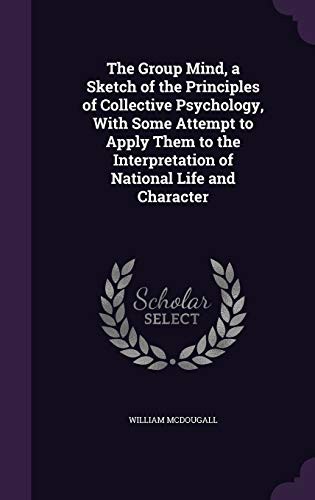
The Group Mind: A Sketch of the Principles of Collective Psychology: With Some Attempt to Apply Them to the Interpretation of National Life and CharacterMcDougall, William
Science
The Group Mind: A Sketch of the Principles of Collective Psychology: With Some Attempt to Apply Them to the Interpretation of National Life and Character
McDougall, William
Ethnopsychology; National characteristics; Social psychology
The dominance of the spirit of independence among the English people he
would explain also from the character of their political institutions
during recent centuries. After recounting the political history of
England from the sixteenth to the eighteenth century, and after showing
how the people during that period repeatedly succeeded in asserting its
liberties against the encroachments of the kings, he wrote—“In England
the course of affairs, which I have endeavoured to trace since the
sixteenth century, had diffused among the people a knowledge of their
own resources and a skill and independence in the use of them, imperfect
indeed, but still far superior to that possessed by any other of the
great European countries,” But he was not wholly satisfied with this
explanation; he added—“Besides this, other circumstances, which will be
hereafter related, had, as early as the eleventh century, begun to
affect our national character and had assisted in imparting to it that
sturdy boldness, and at the same time, those habits of foresight, and of
cautious reserve, to which the English mind owes its leading
peculiarities.”
When we turn to his account of the primary cause of English
independence[116], we find that it was, in his view, that the feudal
system was established by William the Conqueror in a form different from
that obtaining on the continent. The nobles received their lands
directly from the king as grants, and all land owners were made to
acknowledge their direct obligation to him. The nobles were in
consequence too weak to set up their own power against that of the
king, and therefore they called the people to their aid in resisting the
power of the king; hence, the people early acquired rights and
privileges and the habit of organised resistance to the central
authority. “The English aristocracy, being thus forced by their own
weakness, to rely on the people, it naturally followed that the people
imbibed that tone of independence and that lofty bearing, of which our
civil and political institutions are the consequence, rather than the
cause. It is to this, and not to any fanciful peculiarity of race, that
we owe the sturdy and enterprising spirit for which the inhabitants of
this island have long been remarkable.”
“The practice of subinfeudation, became in France almost universal.” The
great lords subgranted parts of their lands to lesser lords, and these
again to others, and so on—“thus forming a long chain of dependence,
and, as it were, organising submission into a system.” In this country,
on the other hand, the practice was actively checked. “The result was
that by the fourteenth century the liberties of Englishmen were
secured,” and the spirit of independence had become a part of the
national character; that is to say, Buckle maintained that three
centuries of a different form of the feudal system sufficed to produce
this profound difference between the French and English peoples.
Public-domain text, read in full here on John Shaqi.
Reviews
Reviews
No reviews yet
Be the first to share your thoughts on this work.
Elsewhere in the archive
Join the Discussion
Join the discussion
Sign in to leave a comment or review.
Sign InorCreate an account