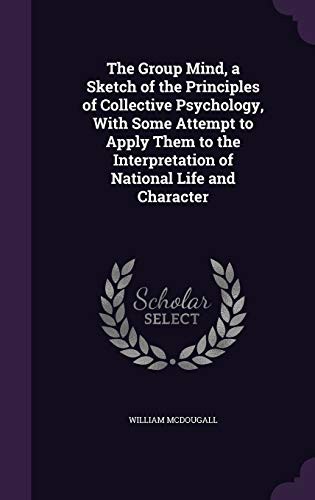
The Group Mind: A Sketch of the Principles of Collective Psychology: With Some Attempt to Apply Them to the Interpretation of National Life and CharacterMcDougall, William
Science
The Group Mind: A Sketch of the Principles of Collective Psychology: With Some Attempt to Apply Them to the Interpretation of National Life and Character
McDougall, William
Ethnopsychology; National characteristics; Social psychology
It is an extremely stable and persistent mode of life and of social
organisation. So long as the geographical conditions remain unchanged,
it is difficult to see how any change would take place in it, how any
progress towards civilisation could begin. And, as a matter of fact, the
people who have remained in these regions continue to lead just the same
patriarchal, pastoral, nomadic life. Long ages of this mode of life may
well put upon a people the stamp of sociability and communism and kill
out individualism and individual initiative! Demolins points out in a
very interesting way how these effects of the patriarchal system of the
pastoral nomads are displayed most clearly still by the population of
southern Russia, who, of all the settled European peoples descended from
such pastoral nomads, have suffered fewest disturbing influences; how
still the individual is subordinated to the community, to the _mir_, by
which all private life and industrial activity is directed and which is
the owner of the principal property, namely the land; and how, in
consequence, the people remain devoid of all individual initiative and
enterprise.
The Celts arriving in Gaul retained these qualities and something of the
patriarchal organisation, although they were no longer simply pastoral
nomads; for, in the course of their migrations, they had been forced to
take up agriculture and the rearing of other domestic animals,
especially the pig, through lack of sufficient open steppe land. While
in this disorganised condition in Gaul, they were overrun by tribes of
the Nordic race, who established themselves as a conquering nobility,
superimposing upon the rudimentary political organisation of the Celts a
loose military organisation of clans; each clan was led by a popular
warrior who attached to himself by his personal qualities as large as
possible a number of clients or clansmen, acquiring rights over their
land and property, in return for the patronage and protection he offered
them. These nobles with their blood relatives were the tall fair-haired
Gauls described by Caesar. The Celts lent themselves readily to this
system based on personal loyalty and leadership, owing to their lack of
independence of character engendered by long ages of the patriarchal
communal régime. And the new social organisation fostered and developed
still more through many generations the spirit of dependence, the
tendency to look for authoritative guidance and control to some
recognised centre of power.
Under the two circumstances, the long régime of patriarchal communism
and the subsequent prevalence for many generations of the clan system,
we may see, according to Demolins, the causes of those deep-seated
tendencies of the French nation (summed up by Buckle in the phrase the
spirit of protection) which throughout their history have played so
large a part in shaping the destinies of the people, and which are still
the source of grave anxiety to many patriotic Frenchmen.
Public-domain text, read in full here on John Shaqi.
Reviews
Reviews
No reviews yet
Be the first to share your thoughts on this work.
Elsewhere in the archive
Join the Discussion
Join the discussion
Sign in to leave a comment or review.
Sign InorCreate an account