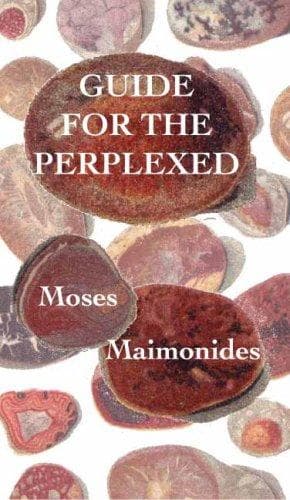
Jewish philosophy -- Early works to 1800; Judaism -- Works to 1900; Philosophy, Medieval -- Early works to 1800
This argument is based on the theory of Determination, and is made much
of by the Mutakallemim. It is the same as the theory which I explained
in discussing the tenth proposition. Namely, when they treat either of
the Universe in general, or of any of its parts, they assume that it
can have such properties and such dimensions as it actually has; that
it may receive such accidents as in reality are noticed in it, and that
it may exist in such a place and at such a time as in fact is the case;
but it may be larger or smaller, may receive other properties and
accidents, and come to existence at an earlier or a later period, or in
a different place. Consequently, the fact that a thing has been
determined in its composition, size, place, accident and time—a
variation in all these points being possible—is a proof that a being
exists which freely chooses and determines these divers relations; and
the circumstance that the Universe or a part of it requires a being
able to make this selection, proves that the Universe has been created
ex nihilo. For there is no difference which of the following
expressions is used: to determine, to make, to create, to produce, to
originate, or to intend; these verbs have all one and the same meaning.
The Mutakallemim give a great many examples, both of a general and a
special character. They say it is not more natural for earth to be
under water than to be above water; who then determined its actual
position? Or, is it more natural that the sun is round than that it
should be square or triangular; for all qualities have the same
relation to a body capable of possessing them. Who then determined one
particular quality? In a similar way they treat of every individual
being; when, e.g., they notice flowers of different colours, they are
unable to explain the phenomenon, and they take it as a strong proof in
favour of their theory; they say, “Behold, the earth is everywhere
alike, the water is alike; why then is this flower red and that one
yellow?” Some being must have determined the colour of each, and that
being is God. A being must therefore exist which determines everything,
both as regards the Universe generally, and each of its parts
individually. All this is the logical consequence of the tenth
proposition. The theory of determination is moreover adopted by some of
those who assume the eternity of the Universe, as will be explained
below. In conclusion, I consider this to be the best argument; and in
another part I shall more fully acquaint you with the opinion I have
formed concerning the theory of Determination.
The Sixth Argument.
Public-domain text, read in full here on John Shaqi.
Reviews
Reviews
No reviews yet
Be the first to share your thoughts on this work.
Elsewhere in the archive
Join the Discussion
Join the discussion
Sign in to leave a comment or review.
Sign InorCreate an account