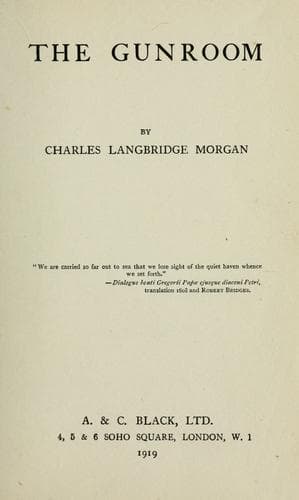
Great Britain. Royal Navy -- Fiction; Seafaring life -- Fiction
On the China Station the naval officer’s concern with war was, perhaps,
more exclusively technical than elsewhere. In home waters the Germans
were as unfamiliar as bogey-men, and the English newspapers were near
at hand. A speech or leading article was potent to awake, even in the
naval mind, some of those vague misgivings concerning Wilhelmshaven
upon which vulgar opinion on foreign affairs was at that time based.
But the newspapers that reached China were stale and little read;
and--most powerful antidote for political animosity--the German Fleet
was a familiar sight, and its officers were frequent guests.
The field of thought concerning war was thus circumscribed. When
the time came, the China Squadron would fight its own independent
battle in its own waters. The chess-board was set. The opposing force
was known and visible. Many a time in Wardroom and Gunroom were the
_Scharnhorst_, _Gneisenau_, _Leipzig_, and _Nürnberg_ compared,
knot for knot, gun for gun, armour for armour, torpedo-tube for
torpedo-tube, with the _Pathshire_ and her comrade ships. No doubt the
Germans made similar calculations; no doubt they, too, cast their eyes
sometimes towards Japan. But, in a subtle manner, the very closeness
of the association of those who were ultimately to be enemies robbed
that association of bitterness. The Germans were excellent seamen, and
pleasant companions at dinner. They danced well, drank well, laughed
well, and could sing a good song. When Fate ended both dance and song
the ensuing duel would be a gentlemanly trial of skill, intensely
interesting, a settling of knotty arguments, a test, for instance,
of what the Engineer-Commander could do with his main engines. The
gun-fire silent at last, the survivors would be picked up and given
whisky, or, if the weather was cold, sloe gin. The battle, important
to civilians for its effects upon trade-routes, Eastern prestige, and
a vast complexity of political issues, would be to those who took part
in it a thrilling conclusion to a technical work which for many weary
years had been hard reading.
It would be a conclusion, an end of a book to which no sequel had been
planned. After it, as after death, would be but that blank fly-leaf
whose whiteness is more emphatic than the written word FINIS. A man
whose whole life has been devoted to one object scarce dares to look
beyond its attainment. The business man speaks uneasily of the years
that are to follow his retirement; the historian wonders how he will
occupy his time when his great work has gone to press; the mother turns
from contemplation of the hour in which her child, made man by her pain
and endeavour, goes from her into the world. And the naval officer
looked infrequently and with reluctance beyond the crowning of his work.
Public-domain text, read in full here on John Shaqi.
Reviews
Reviews
No reviews yet
Be the first to share your thoughts on this work.
Elsewhere in the archive
Join the Discussion
Join the discussion
Sign in to leave a comment or review.
Sign InorCreate an account