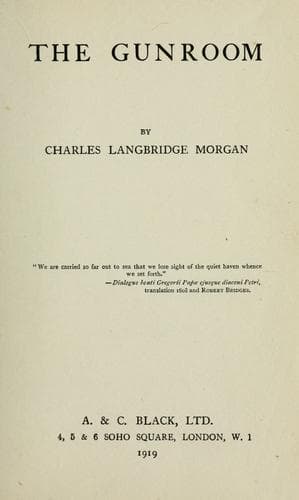
Great Britain. Royal Navy -- Fiction; Seafaring life -- Fiction
The effect was dull, unspeaking misery; eyelids that closed, and,
being forced open, closed again; limbs gnawed by weariness; a weakness
of control that brought hysterical tears and laughter very near. The
mind strayed back to childhood and leapt out in jagged flashes towards
licentiousness. Aggett could do what he liked with them. No insult
could provoke now any desire to protest. They obeyed like whipped curs.
“Yes, sir.... No, sir.... I’m sorry, sir.”
“It’s taming ’em,” said Aggett.
Nervous exhaustion, so potent to produce obsessions, urged John to the
reading of books in snatches and Driss to interminable calculations
of minutes. Driss analyzed his day with pitiless accuracy. He would
confront John with pieces of paper on which he had written in his neat
round-hand the number of minutes he spent in sleep, in watch-keeping,
in standing by his gun, in drawing his sketch, in eating his meals.
And John, seeing from these tables that there was no time for reading,
became, for that reason, the more determined to read. He read at meals
until Hartington, who, when he was present, insisted that the Gunroom
should observe at least some of the conventions, told him to put his
book away.
“It’s the only time I can read,” John exclaimed. “You know it is the
only time I have.”
“I’m sorry,” Hartington answered; “but I’m not responsible for your
routine. I can’t have reading at Mess.”
And John, made unreasonably angry by this excellent rule, read at odd
moments for five or ten minutes at a time, crouching on his sea-chest
when he came off watch at midnight, wasting the precious interval
before he went below again at 4 a.m. He read, too, between breakfast
and Divisions, between tea and Quarters, between Sunday Divisions and
Church. He turned to his book with almost fierce devotion on occasions
when no one else would have thought it worth while to open covers that
would so soon have to be closed again. And he wrote--wild blank verse.
The scansion missed sometimes, but he did not care. He would write no
lyrics now; his indignation would not pause for rhymes. Never had his
mind been so full of themes demanding expression; never had words come
to him like this unsummoned. Tremendous phrases woke him in the night,
so that he lay in his hammock, his head a little raised, listening.
He heard nothing but the engine’s throbbing and the far-away clashing
of the revolution-telegraph. And he would lie down again and hide his
face, wondering how, even for a moment, he had been amazed and excited
by a phrase which, as he considered it, he saw to be without shape or
meaning.
Public-domain text, read in full here on John Shaqi.
Reviews
Reviews
No reviews yet
Be the first to share your thoughts on this work.
Elsewhere in the archive
Join the Discussion
Join the discussion
Sign in to leave a comment or review.
Sign InorCreate an account