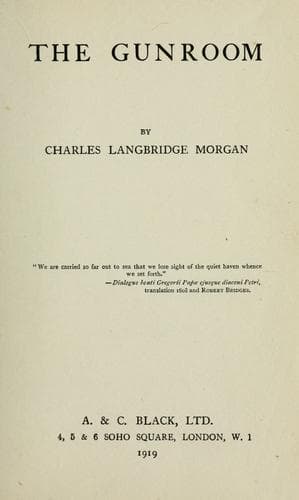
Great Britain. Royal Navy -- Fiction; Seafaring life -- Fiction
John and Margaret, like all the other young creatures, had no idea of
this. They felt as if they were telling each other secrets--which is
the best known of love’s tricks. In truth, they were but beginning to
discover the secrets of themselves, and had not yet had time to become
so confused as the rest of us in life’s attempt to draw a boundary
between the soul and the body. Dust to dust, ashes to ashes! There was
no dust, there were no ashes, their hearts argued; therefore all--her
lips and the colour the wind had whipped into her cheeks, his frank
eyes, and brown, fine-cut hands--all must have something of the soul
in them. What reason had they to doubt? They were not afraid, and fear
goes hand in hand with the Devil. Their happiness was of the clean kind
they would have liked to sing about to all the world.
So it happened that they danced together that evening with all the
memories of daylight and keen air to lend magic to the flowers and the
sparkling lamps and the murmur of stringed instruments.
“I love the little pointed shadows under everybody’s feet,” she said,
“and the vague pools of light in the polished floor. It’s better than
fairies on the village green.”
“That’s not an absolute opinion,” he answered, laughing. “Shouldn’t we
be on the side of the fairies if we were dancing on green grass now?”
To him it mattered only that they were dancing together, and her
silence acquiesced in his mood.
“There’s any number of people,” he exclaimed, “who are wishing the
music would stop. It’s strange to think of other people being tired and
bored.”
“Perhaps this isn’t the music they care for.”
“The old people?”
“Yes; probably they remember other tunes. Shall I ask the orchestra
to play something that was heard all over London thirty--forty--fifty
years ago? Shall I?”
They are for ever asking each other questions.
“Do you think anyone would dance to it?”
“I don’t know. Would we dance to _this_--fifty years on?”
He brushed aside the unimaginable future. At this moment she was his,
her voice speaking close to him, the curve of her cheek and forehead
clear beneath his eyes. He imagined suddenly that he would remember
this instant, that his future would be full of it; and it took to
itself already some of the glamour of history.
“Oh,” said she, “there’s Mr. Ordith watching us!”
The charm was lifted. He could not endure that another should peer over
his shoulder into the history-book of fancy, or that a stranger’s eye
should witness the building of this magic temple in which the moment
was to be preserved against the assaults of all time. Soon the music
faded into silence. A few feet slid on, and then stopped. The room
filled with human voices.
“That’s the end,” she said softly, and he did not find the remark
unnecessary. They sat down somewhere and talked little, each aware
of anticlimax. John was almost glad when Ordith, graceful and
self-confident, came up and took her away.
Public-domain text, read in full here on John Shaqi.
Reviews
Reviews
No reviews yet
Be the first to share your thoughts on this work.
Elsewhere in the archive
Join the Discussion
Join the discussion
Sign in to leave a comment or review.
Sign InorCreate an account