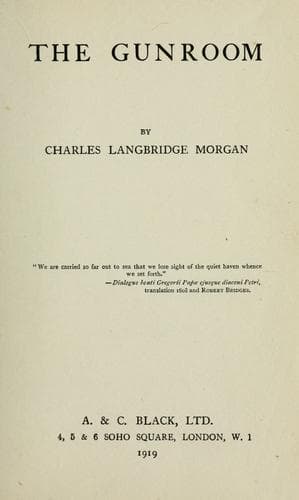
Great Britain. Royal Navy -- Fiction; Seafaring life -- Fiction
After dinner on the evening of their arrival, sitting together in the
verandah that ran the whole length of the three bungalows, and watching
their cigarette smoke twist and disappear against a sky of so heavy a
purple that the stars seemed to be embedded in it, they discussed their
plans for the morrow--discussed them happily and at leisure, knowing
that their time was their own, and that any decision made to-night
might be freely reversed in the morning. As they were on the point of
leaving the _Pathshire_ an English mail--the first to reach them since
they left home--had been distributed, and each had brought his share
to Kandi unread. “Let’s keep them,” John had suggested, “until after
dinner to-night, when we shall be alone and quiet, and clear away from
the ship.” And now they brought out their letters from their pockets
and began the reading they had so long postponed. Soon there was little
sound but that of pages being turned. From far down the verandah came
the murmur of indistinguishable voices, and from time to time the hiss
of a match or the sharp tinkle of a liqueur glass.
Among John’s letters was one from Margaret, which he did not open until
all the others had been returned to their envelopes. Then he read it
slowly. When he began he was content with the moment. This evening’s
beauty and quietness, so wonderful a contrast to the nights he had
spent in the _King Arthur_, seemed a satisfaction of all his desires.
For two days he was independent of routine--free to control his own
movements, to read, to sleep, to go in and out according to his will.
He and Hugh were filled with the spirit of content that visits all men
at the beginning of their holiday. There had seemed no need to look
further, to question motives or consequences. The night was pleasant;
this letter of Margaret’s would add pleasure to the night.
But, as he read, he began to remember many things which the freedom of
his new life from persecution had caused him to forget. She spoke of
London, of political plots and rumours, of the strength or weakness
of new movements, of the expansion of new ideas. New books, new
expressions of opinion; the words of men who had been her father’s
guests; fears of a strike at Ibble’s--her letter was extraordinarily
suggestive of keenness and activity. Much had happened, more was about
to happen--and this in a London many weeks away. What, Margaret asked,
had he been doing? What had he written? He looked back over weeks
of inactivity. He had done nothing but talk to Hartington. Days had
slipped by--precious days. Since he left England he had read little,
had created nothing, had not tried to create. The storm of the _King
Arthur_ being over he had relapsed into lazy content. Time had sped.
Public-domain text, read in full here on John Shaqi.
Reviews
Reviews
No reviews yet
Be the first to share your thoughts on this work.
Elsewhere in the archive
Join the Discussion
Join the discussion
Sign in to leave a comment or review.
Sign InorCreate an account