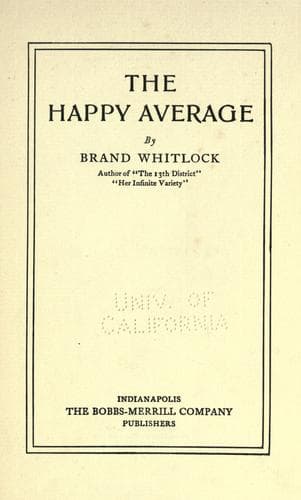
Betrothal -- Fiction; Courtship -- Fiction; Middle West -- Fiction; United States -- Social life and customs -- Fiction
"Well," Marley replied, with a seriousness that impressed him, at least,
as the ripe wisdom of maturity, "I am not much older in years, but I am
in experience, and in knowledge of life. You see, dear, you can measure
time by the calendar, but you can't measure life that way. And Weston
says that there is no calling that will give a man experience so quickly
as newspaper work. You know we see everything, and we get a smattering
of all kinds of knowledge. Weston says that is all that reconciles him
to the business; he says a man learns more there than he ever does in
college. He considers the training invaluable; he says it will be of
great help to him in literature, if he can ever get into literature--he
isn't sure yet that he can. He can tell better after his book is
published. And he says a newspaper experience will help me in the law,
too, that is," Marley added, with a whimsical imitation of Weston's
despairing uncertainty, "if I can ever get into the law."
"You think a great deal of Mr. Weston, don't you?" said Lavinia.
"He's the finest fellow in the world, and the best friend I ever had."
Marley had a curious intuition that Lavinia was a little jealous of
Weston. He immediately sought to allay the feeling with this argument:
"You see, when a man does all for a fellow that Jim has done for me, and
when you have lived with him, and shared your haversack with him, and he
with you, like two soldier comrades, you get right down to the bottom of
him. And I want you to know him, dear, I know you'll like him."
Lavinia was silent, and Marley had a fear that she might not accept
Weston quite so readily.
"He has done me a world of good," he went on. "He has taught me much, he
has corrected my reckoning in more ways than one. He has taught me much
about books; and he has taught me to look sanely on a life that isn't,
he says, always truthfully reflected in books. And besides all, if it
hadn't been for him, if he had not kept me at it and urged me on, I
think I should have been doomed for ever to remain a poor newspaper
man."
"Don't you like newspaper work?" she asked with a shade of
disappointment in her tone.
"I did, but I like it less every day. It's a hard and unsatisfactory
life, and it has no promise in it. A man very soon reaches its highest
point, and then he must be content to stay there. It's the easiest thing
for a young fellow to get a start in, if he's bright; I suppose I'm
making more money than any of the young lawyers in Chicago; but because
it is so easy is the very reason why it is hardly worth while. Things
that are easily won are not worth striving for."
"And you're going to get out of it?"
Public-domain text, read in full here on John Shaqi.
Reviews
Reviews
No reviews yet
Be the first to share your thoughts on this work.
Elsewhere in the archive
Join the Discussion
Join the discussion
Sign in to leave a comment or review.
Sign InorCreate an account