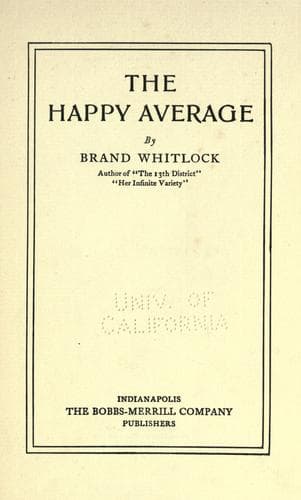
Betrothal -- Fiction; Courtship -- Fiction; Middle West -- Fiction; United States -- Social life and customs -- Fiction
"Yes," she whispered, "and think of the long years of happiness!"
They stood and gazed, looking down the long vista of years that
stretched before them as smooth and peaceful as the white road to Mingo.
A subtile change was passing over the face of the road; shadows were
stealing toward it, and it was growing gray. The trees that still were
green were darkening to a deeper green, but the colors of those that had
changed flamed all the brighter. The sun shone more golden on the shocks
of corn, the sky was glowing pink in the west, the water-works pond was
glistening as the sun's shafts struck it more obliquely. A fine powder
hung in the peaceful air.
"How beautiful the fall is!" said Lavinia.
"Yes, I love it," said Marley. "But do you know, dear, that I never
liked it before? It always seemed sad to me. But you have taught me to
love many things. You don't know all that you have done for me!"
She stood in her blue dress, with her hands folded before her. Marley
looked at her hands, and at her white throat, and at her hair, its brown
turned to a golden hue by the clear light; then he looked into her eyes.
A sudden emotion, almost religious in its ecstasy, came over him. He
bent forward.
"Oh!" he exclaimed. "Do you know how beautiful you are! I worship you!"
"Don't, Glenn," she said, "don't say that!" The reflection of a
superstitious fear lay in her eyes.
"Why?" he said defiantly. "It's all true. You are my religion."
"You frighten me," she said.
Marley laughed.
"Why!" he exclaimed, "there's nothing to fear. Isn't our future assured
now?"
CHAPTER XIX
WAKING
Carman was inducted into office the first Monday in December, quietly,
as the _Republican_ said, as though it reflected credit on the new
county clerk as a man who modestly avoided the demonstration that might
have been expected under such circumstances. Marley, in the hope of
seeing his own name, eagerly ran his eyes down the few lines that were
devoted to the occurrence, but his name was not there, the
_Republican's_ reporter, as he felt, being a man who lacked a sense of
the relative importance of events.
Marley had taken no part in the campaign, though Wade Powell wished him
to, and suggested every now and then that he speak at some of the
meetings that were being held in the country schoolhouses. Powell said
it would be good practice for him in a profession where so much talking
has to be done, and he found other reasons why Marley should do this, as
that it would extend his acquaintance, and give him a standing with the
party; but, though Marley was always promising, he was always
postponing; the thought of standing up and speaking to the vast
audiences his imagination was able to crowd into a little school-room
filled him with fear, and he never could bring himself to consent to any
definite time. Besides this, he could not find an evening he was willing
to spend away from Lavinia.
Public-domain text, read in full here on John Shaqi.
Reviews
Reviews
No reviews yet
Be the first to share your thoughts on this work.
Elsewhere in the archive
Join the Discussion
Join the discussion
Sign in to leave a comment or review.
Sign InorCreate an account