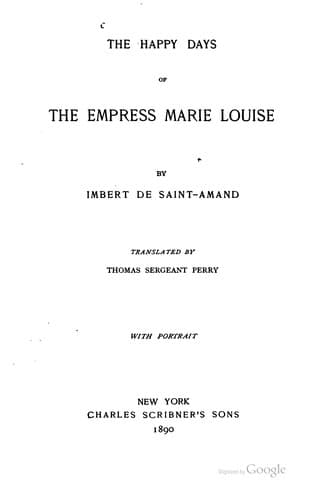
The Happy Days of the Empress Marie LouiseImbert de Saint-Amand
History
The Happy Days of the Empress Marie Louise
Imbert de Saint-Amand
Marie Louise, Empress, consort of Napoleon I, Emperor of the French, 1791-1847
The procession reached the entrance of the Tuileries gardens, passed
beneath a triumphal arch, wound around the basin of water, by the side
of the flower-beds, which the crowd had respected, and drew near to
the palace walls. The central pavilion had been decorated with a large
orchestra, divided by a passage leading to the vestibule. In the middle
of the orchestra was an arch, on top of which was set a tribune in the
shape of a tent. On all the bas-reliefs the panels and other ornaments
were initials surrounded with flowers and various emblems and
allegories. The carriages passed under this arch; the Emperor and
Empress alighted in the vestibule and ascended the grand staircase.
Marie Louise entered the bedroom of the grand apartment by the great
door, which was thrown wide open. The maids-of-honor of France and
Italy, as well as the ladies of the bedchamber, were shown thither from
the throne-room through the dressing-room. They removed the Empress's
court cloak, and put on her the Imperial cloak. Meanwhile the procession
was forming again in the Gallery of Diana, and as soon as Their
Majesties had arrived, it started again, entered the long Gallery of the
Louvre, passing through its entire length, to the _Salon Carré_, which
had been turned into a chapel for the religious ceremony.
This magnificent gallery presented a fine appearance, divided, as it is,
into nine unequal compartments by arches rising from columns of rare
marble with gilded bases and capitals. It is the famous gallery in which
are gathered the finest pictures of the masters of every school. The
invited guests had been gathering there since ten o'clock. They ascended
thither by two staircases, one leading from the quay, the other from the
Place du Carrousel to the central pavilion. The Imperial party alone was
to enter by the door of the Pavilion of Flora. Two rows of benches had
been placed the whole length of the gallery for the ladies, and two rows
of men were to stand behind them, so that there was room for about eight
thousand persons without crowding. Bars had been placed in front of
the first line of benches to leave an unencumbered passage-way for the
Emperor and Empress. Thanks to the exertions of the officers of the
Imperial Guard, who discharged their duty with perfect courtesy, four
thousand women, in their most brilliant dresses, without trouble,
without confusion, and as many men, all chosen from the highest society,
took their places when the procession was to pass. They had to wait not
less than five hours, but the order was so good that every one could
easily leave and resume his place. The gallery was turned with a
magnificent promenade in which Paris was treated to a display of the
elegance and luxury of its leading men and most fashionable women.
Refreshments of various kinds were handed about while orchestras played
marches or pieces composed by Paër, the famous leader of the Emperor's
music. The waiting was thus a long entertainment. At three in the
Public-domain text, read in full here on John Shaqi.
Reviews
Reviews
No reviews yet
Be the first to share your thoughts on this work.
Elsewhere in the archive
Join the Discussion
Join the discussion
Sign in to leave a comment or review.
Sign InorCreate an account