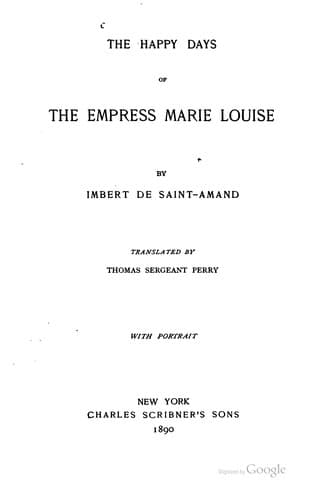
The Happy Days of the Empress Marie LouiseImbert de Saint-Amand
History
The Happy Days of the Empress Marie Louise
Imbert de Saint-Amand
Marie Louise, Empress, consort of Napoleon I, Emperor of the French, 1791-1847
The festival continued till late into the night. "All the happy
families," says the _Moniteur_, "returned to their peaceful homes after
a long absence. Every one had had the happiness of gazing at the Emperor
and his August spouse, and all could feel that they too had been seen of
them, so thoroughly did the feeling of the benevolence and affability
with which their homage had been received by Their Majesties, repay
the most enthusiastic testimonials of love and gratitude which a great
nation has ever been able to present to its rulers."
Tuesday, April 3, was the day for the presentation at the Tuileries to
the Emperor and Empress, seated on their throne, of the great bodies of
the State. The Emperor replied to the address of the Senate in these
words, "I and the Empress merit the sentiments which you express by the
love we nourish for our people." The President of the deputation from
the Kingdom of Italy spoke in Italian. "Our people of Italy,"
replied the Emperor, "know how much we love them. As soon as possible,
I and the Empress wish to go to our good cities of Milan, Venice, and
Bologna, to give new pledges of our love for our Italian people."
The thirteen Italian cardinals who were unwilling to be present at the
wedding the day before were in the Hall of the Marshals, where, amid a
throng of prelates, officers, functionaries, and court ladies, they were
waiting for the moment to pass before their formidable master. They
had been there for three hours, in great anxiety, when aides appeared,
bidding them depart at once, the Emperor being unwilling to receive
them. Much disconcerted, they made their way with difficulty through the
crowd to their carriages. When the other cardinals, who had been present
at the wedding, presented themselves in the throne-room, Napoleon stood
up and violently denounced their expelled colleagues. Cardinal Consalvi,
formerly Secretary of State to Pius VII., was especially attacked.
"The others," he said, "may perhaps be excused on the score of their
theological prejudices, but he has offended me from political motives.
He is my enemy, and he seeks to revenge himself for my driving him from
the ministry. That is why he has made this deep plot against me, raising
against my dynasty a pretext of illegitimacy, a pretext which my enemies
will be sure to lay hold of when my death shall have freed them from
the fear that restrains them to-day." It was in vain that the offending
thirteen cardinals wrote together an apologetic letter in which they
said that they had never wished to judge the validity of the Emperor's
first marriage or to throw any doubts on the lawfulness of the second.
Napoleon remained implacable. He turned them out of their office,
stripped them of their cardinals' robes, bade them resume their attire
as simple priests, so that afterwards they were known as the black
cardinals, in distinction from the others, the red cardinals. He
deprived them of all their estates, ecclesiastic or inherited, and
Public-domain text, read in full here on John Shaqi.
Reviews
Reviews
No reviews yet
Be the first to share your thoughts on this work.
Elsewhere in the archive
Join the Discussion
Join the discussion
Sign in to leave a comment or review.
Sign InorCreate an account