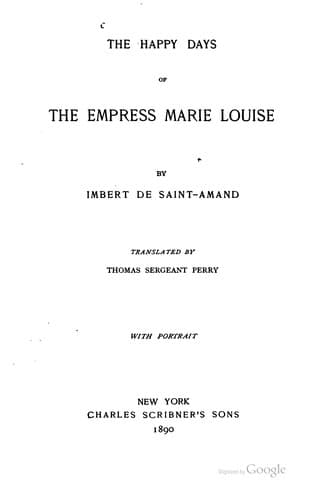
The Happy Days of the Empress Marie LouiseImbert de Saint-Amand
History
The Happy Days of the Empress Marie Louise
Imbert de Saint-Amand
Marie Louise, Empress, consort of Napoleon I, Emperor of the French, 1791-1847
It was not till four in the morning that he returned to Saint Cloud,
where he had been most anxiously awaited. "From the time that the
Empress arrived," we read in Constant's Memoirs, "we had felt the
keenest anxiety; every one in the palace had been most uneasy about the
Emperor. At last he arrived, unharmed, but very tired; his dress in
disorder, his face scorched, his clothes and stockings all blackened and
singed by the fire. He went straight to the Empress's room, to console
her for the fright she had had; then he went to his own room, flung his
hat on the bed, dropped into an easy-chair, saying, 'Heavens! what a
festivity!' I noticed that his hands were all blackened; he had lost his
gloves at the fire. He was overwhelmed with sadness, and he spoke with
an emotion such as I had seen in him only two or three times in his
life, and never about his own misfortunes. I remember that he expressed
a fear that the terrible event of that night betokened future
calamities. Three years later, in the Russian campaign, he was told one
day that Prince Schwarzenberg's army corps had been destroyed, and that
the Prince himself had perished. It happened that the news was false;
but when it was brought to the Emperor, he said, as if in accordance
with a thought that had long haunted him, 'It was he then whom that evil
omen threatened!'"
The morning of the next day Napoleon sent his pages to learn the news.
The accounts they brought back were most gloomy: the Princess de la
Leyen had died from her injuries; General Touzart was in a desperate
condition, as well as his wife and daughter, who, in fact, died the same
day. Prince Kourakine, the Russian Ambassador, was seriously injured;
he had made a misstep on the staircase leading to the garden, and had
fallen senseless into the flames, which, fortunately, had been unable to
get through his coat of cloth of gold and the decorations which
covered him like a cuirass; nevertheless, it was many months before he
recovered. "Prince Joseph de Schwarzenberg," says the _Moniteur_ of July
3, 1810, "spent the night in looking for his wife, whom he could not
find at the Embassy or at Madame Metternich's. He was still ignorant
of his loss when at daybreak there was found in the ball-room a corpse
which Dr. Gall thought that he recognized as that of the Princess
Pauline de Schwarzenberg. Further doubt was impossible when her jewels
with her children's initials, which she wore about her neck, were
recognized. Princess Pauline de Schwarzenberg was the daughter of the
Senator von Avenberg, and the mother of eight children. She was as
renowned for her personal charms as for the distinction of her mind and
heart. The act of devotion which cost her her life shows how much her
loss is to be regretted, for death was certain amid the fury of the
flames. Only a mother would have dared to face the danger."
Public-domain text, read in full here on John Shaqi.
Reviews
Reviews
No reviews yet
Be the first to share your thoughts on this work.
Elsewhere in the archive
Join the Discussion
Join the discussion
Sign in to leave a comment or review.
Sign InorCreate an account