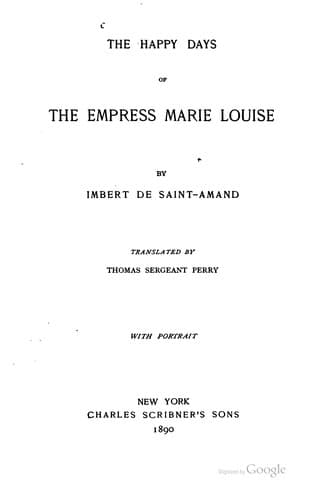
The Happy Days of the Empress Marie LouiseImbert de Saint-Amand
History
The Happy Days of the Empress Marie Louise
Imbert de Saint-Amand
Marie Louise, Empress, consort of Napoleon I, Emperor of the French, 1791-1847
Marie Louise, who had been interrupted at this point, continued as
follows: "I have just come from the Emperor, where I heard a terrible
piece of news. Princess Pauline Schwarzenberg has been found, burned to
a crisp.... Her diamonds were lying near her. She wore on her neck
a heart in brilliants, on which were engraved the names of her two
daughters, Eleonore and Pauline, and it was by this that she was
recognized. She leaves eight children, and was expecting another. Her
family is inconsolable. Kourakine is very low; so is Madame Durosnel,
the general's wife. I am so distressed that I cannot stir."
The Emperor Francis wrote to his son-in-law about this distressing
event: "July 15. My Brother and very dear Son-in-law,--It is with the
greatest satisfaction that I have heard that Your Imperial Majesty, as
well as the Empress, my beloved daughter, has escaped the melancholy
accidents that occurred at the ball of my Ambassador, Prince
Schwarzenberg. I cannot express to you, my brother, my gratitude for the
tokens of your interest which you manifested on that occasion, and for
your personal exertions, as noble as they were courageous, to arrest
the progress of the disaster. Count Metternich and Prince Schwarzenberg
cannot find words to express their profound gratitude for your kindness
and anxiety, and I beg Your Majesty to receive this expression of all
that I have experienced in reading their reports."
The calamity produced a most melancholy impression. It recalled to
every one the disasters that attended the festivities given to Marie
Antoinette forty years before. This ball, followed by a horrid
catastrophe, this grand drawing-room, vanishing in flames, were they not
omens of evil? Was not the great empire to perish in the same way? This
fire, bursting forth in a night of revelry and triumph, was it not like
a prophecy of a still more terrible fire, that which laid Moscow in
ashes? But nations have short memories; gloomy presentiments soon
vanish. The Empire was then so glorious that a passing incident could
not seriously disturb it, and a few days after the catastrophe it was
forgotten. Every one, even the enemies of France, felt the fascination
of this most wonderful career which formed the strangest and most
improbable of romances.
XIX.
THE BIRTH OF THE KING OF ROME.
Public-domain text, read in full here on John Shaqi.
Reviews
Reviews
No reviews yet
Be the first to share your thoughts on this work.
Elsewhere in the archive
Join the Discussion
Join the discussion
Sign in to leave a comment or review.
Sign InorCreate an account