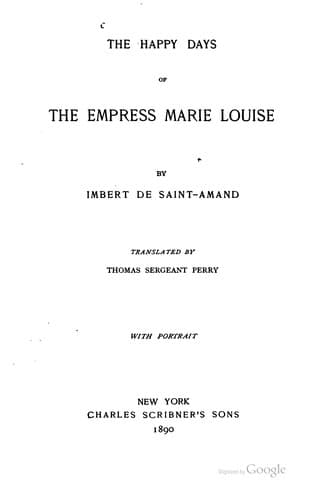
The Happy Days of the Empress Marie LouiseImbert de Saint-Amand
History
The Happy Days of the Empress Marie Louise
Imbert de Saint-Amand
Marie Louise, Empress, consort of Napoleon I, Emperor of the French, 1791-1847
Early in July, when their hopes were still vague, Marie Louise wrote to
her father: "Heaven grant that they may prove true! The Emperor would
be so happy!" And later she wrote: "I can assure you, dear papa, that
I look forward without dread to this event, which will be a great
happiness." The official notification of her condition was not made till
November, when Napoleon sent the Baron de Mesgrigny to Vienna with two
letters, one from himself and one from the Empress, to the Emperor
Francis. "This letter," Marie Louise wrote, "is to announce to you, dear
papa, the great news. I take this opportunity to ask your blessing for
me and for your grandchild. You may imagine my delight. It will be
complete if the event shall bring you to Paris." The hope of seeing her
father soon was continually present with her, and Napoleon encouraged
it. As she wrote to her father, "My husband often speaks of you and is
anxious to see you again."
The Emperor Francis answered his son-in-law, December 3, 1810, in these
terms: "My Brother and very Dear Son-in-law,--The letter which M. de
Mesgrigny has handed to me fills me with the liveliest joy. The
happy event which it mentions arouses my fullest sympathy. My best
wishes go out to you, my brother, and the present condition of things
which your letter announces, is too intimately connected with our
reciprocal satisfaction for me not to set the greatest store, as friend
and father, by the news you give me. Everything which Your Majesty says
about your domestic happiness is corroborated by my daughter; in no way
can you, my brother, contribute more directly to my own. I knew the
excellent traits of my daughter when I entrusted her to you, and
Your Imperial Majesty must be sure that my only consolation for the
separation is her happiness, which is inseparable from that of her
husband."
Napoleon asked of the Bishops and Archbishops special prayers in behalf
of the Empress. December 2, the anniversary of his coronation, and of
the battle of Austerlitz, he gave an audience to the Senate, who came
to thank him for the notification of the Empress's expectations. At the
Tuileries that day was celebrated by mass a _Te Deum_, an illumination,
and a play. Twelve young girls, who were dowered by the Empress, were
married in the Cathedral, and there was a generous distribution of alms.
The Emperor founded a society of Maternal Charity, to aid poor women
during their confinement. The Empress was appointed patroness of the
society, and Mesdames de Ségur and de Pastoret Vice-Presidents; a
thousand ladies joined it, and fifteen held offices; there was a Grand
Council which sat in Paris, and administrative councils were appointed
for the provinces. The Grand Almoner was made secretary, and there was a
general treasurer. The capital of the society amounted to five hundred
thousand francs, raised in part from the public funds, and in part by
voluntary subscriptions, which soon furnished the required sum.
Public-domain text, read in full here on John Shaqi.
Reviews
Reviews
No reviews yet
Be the first to share your thoughts on this work.
Elsewhere in the archive
Join the Discussion
Join the discussion
Sign in to leave a comment or review.
Sign InorCreate an account