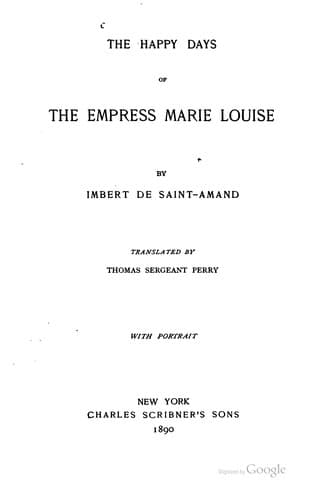
The Happy Days of the Empress Marie LouiseImbert de Saint-Amand
History
The Happy Days of the Empress Marie Louise
Imbert de Saint-Amand
Marie Louise, Empress, consort of Napoleon I, Emperor of the French, 1791-1847
All this while the people of Paris were in a state of expectancy,
wondering whether the child was to be a boy or a girl. If a boy, he
would have a fine-sounding name. According to a decree calling the
Eternal City the second city of the French Empire, which had become the
capital of a simple department,--the department of the Tiber,--and in
accordance with old usages of the Holy German Empire, by which the
prince destined to succeed the Germanic Caesar, was called King of the
Romans before bearing the title of Emperor, Napoleon's son was to be
called the King of Rome. But would Napoleon have a son? Would Heaven
crown his unexampled prosperity with this new favor? That was the
subject of conversation everywhere, in the grandest mansions as in the
humblest garrets. From daybreak of March 20th the Tuileries garden was
crowded with people of all ages and conditions. The courtyards and quays
were thronged. In the garden, along the terrace, in front of the palace,
a rope was stretched from the grating by the Pont Royal to the Pavilion
de l'Horloge. The crowd was so fearful of disturbing the Empress that
this frail barrier, this simple rope, was more respected than would have
been a lofty wall. The assemblage, which had been growing ever since six
o'clock, remained at some distance from the rope, and only spoke in a
low voice. They waited in extreme impatience, yet in perfect quiet,
for the sound of the cannon of the Invalides. If it was a girl, only
twenty-one guns would be fired; if a boy, there would be a hundred and
one.... Every window was opened; in the squares and streets everything
stood still,--foot-passengers, horses, carriages. The cannon of the
Invalides was heard, and the anxious multitudes in deep emotion began to
count, at first very low, but gradually louder--one, two, three, four,
and so on up to twenty. Then the excitement was tremendous. Twenty-one.
Is that all? No; there is the twenty-second, and the rest of the hundred
and one are to follow; but there was no more need of counting: Napoleon
had a son! At once the enthusiasm of the multitude broke forth like a
volcano. Cheers, hats tossed in the air, loud cries of joy, universal,
noisy delight, what a sight for the Emperor, as he stood at one of the
Empress's windows, gazing in silence at the rapturous crowd! Tears
flowed down his cheeks. "Never had his glory brought a tear to his
eyes," Constant informs us; "but the happiness of fatherhood softened
this soul which the most brilliant victories, the sincerest tributes
of public adoration, had left untouched. Indeed, if Napoleon ever had
reason to believe in his good fortune, it was on the day when the
Archduchess of Austria made him the father of a king, him who had begun
as the younger son of a Corsican family. In a few hours the event which
France and Europe had been awaiting was a festival in every family."
Public-domain text, read in full here on John Shaqi.
Reviews
Reviews
No reviews yet
Be the first to share your thoughts on this work.
Elsewhere in the archive
Join the Discussion
Join the discussion
Sign in to leave a comment or review.
Sign InorCreate an account