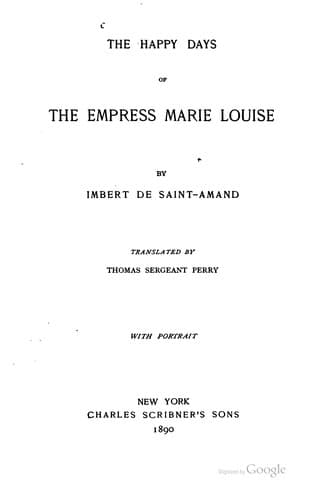
The Happy Days of the Empress Marie LouiseImbert de Saint-Amand
History
The Happy Days of the Empress Marie Louise
Imbert de Saint-Amand
Marie Louise, Empress, consort of Napoleon I, Emperor of the French, 1791-1847
When we think of the end of this matter, and reflect that this King of
Rome was to be deprived not merely of his title of Prince Imperial and
of King, but of the name of Napoleon and of Bonaparte, that he was
destined to be known as Francis, Duke of Reichstadt, and to be buried
in the Church of the Capuchins in Vienna, in Austrian uniform, is it
possible to repress a sad smile at the simple optimism of courts? In
1811 illusions were universal. "Amid all our triumphs," says General de
Ségur, "when even our enemies, at last resigning themselves to their
fate, seemed hopeless, or had rallied to the side of our Emperor, what
pretext was there for gloom, or for any foreboding of a total or partial
eclipse? It was pleasanter to trust in his star, which dazzled us from
its height, so many wonders had it wrought!... And how many of us,
despite the ever-shifting sky of France, when we see it clear, are
tempted to think that no change threatens, and are every day surprised
by some sudden storm! Who, when he hears that some apparently healthy
person has dropped dead, is not astonished? We were in just such case,
when, March 20, 1811, Heaven, feeding our pride to make our humiliation
deeper, vouchsafed the conclusion of the fairy-show and completed the
illusion with the birth of the King of Rome." Napoleon, in the enjoyment
of every happiness and of every triumph, had reached the lofty summit of
glory and prosperity; from this he was soon to fall in a swift, giddy
flight, at the end of which opened a terrible abyss, full of blood and
tears.
XX.
THE RECOVERY.
Marie Louise made a quick recovery, and her restoration to health
delighted both her husband and herself. Her father, the Emperor of
Austria, sympathized with their happiness, as is shown by the following
letter of his to Napoleon, dated March 27, 1811: "My Dear Brother and
Son-in-Law,--It is impossible for me to express in a formal letter of
this sort the satisfaction I feel at the good news you have sent to me
about my daughter. Your Majesty must already know my keen interest in an
event of such importance, both for her and for France, as the birth of a
prince, and the fact that this is safely over only augments my joy. May
Heaven preserve this new pledge of the ties uniting us! Nothing could be
more precious or surer to unite firmly the happy bonds existing between
the two Empires."
Napoleon, on the 20th of March, had despatched to Vienna Count Nicolai,
who arrived there on the 28th. On that day Francis wrote to his
son-in-law: "My Brother and Dear Son-in-Law,--Count Nicolai has this
moment delivered to me the two letters of Your Majesty. Since I am
unwilling to delay a courier, who is on the point of departure, and will
carry to Your Majesty and to the Empress the first expressions of
my delight at the happy event, I postpone my formal answer to Your
Majesty's invitation to hold his son at the baptismal font, but I hasten
to take this opportunity to say that I accept so agreeable a duty.
Public-domain text, read in full here on John Shaqi.
Reviews
Reviews
No reviews yet
Be the first to share your thoughts on this work.
Elsewhere in the archive
Join the Discussion
Join the discussion
Sign in to leave a comment or review.
Sign InorCreate an account