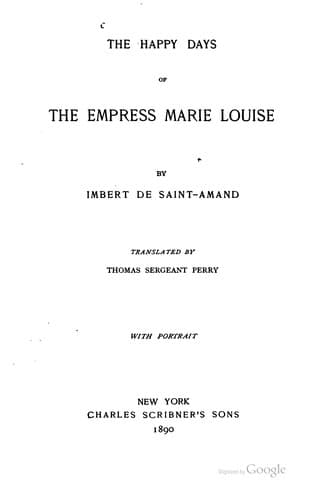
The Happy Days of the Empress Marie LouiseImbert de Saint-Amand
History
The Happy Days of the Empress Marie Louise
Imbert de Saint-Amand
Marie Louise, Empress, consort of Napoleon I, Emperor of the French, 1791-1847
It would be hard to imagine all the homage paid at this time to the
Imperial pair. Dithyrambs upon the birth of the King of Rome were
composed in every language of Europe except the English. There was a
real avalanche of poems, odes, epistles; in less than a week the Emperor
received more than two thousand of these tributes. Probably he read very
few of these extravagant compositions, which were crammed panegyrics
and allegories of the Greek mythology. The sum of one hundred thousand
francs was divided among the authors of these official poems. "Of all
these memorials, the most curious that flattery ever elevated," Madame
Durand writes, "is a collection of French and Latin verses, entitled,
'The Marriage and the Birth,' which was printed at the Imperial press,
and appointed by the University to be given as a prize to the pupils
of the four grammar schools of Paris, and of those in the provinces,
thereby assuring a ready sale. In this heap of trash figures the names
of all the authors who, when the giant had fallen, insulted his remains
and burned their incense before the new deity who took his place.
"As Béranger said about those poets:--
"They are, like the confectioners,
Friends of every baptism."
The _Moniteur_, in its number of June 9, 1811, the day of the King of
Rome's baptism, spoke as follows: "The happy event which, at the moment
of writing these lines, is throughout this vast Empire the object of the
thanksgivings which a great people can offer to Heaven; which inspire
songs of happiness in our temples, our public places, our peaceful
cities, our fertile fields, and in the camps of our invincible warriors;
which fulfils at once the wishes of the people for the happiness of
their Sovereign, and those of the Sovereign for the firm establishment
of the institutions he has consecrated to the prosperity of his people,
ought more than any other to kindle the fervor of our poets and fill
them with a lively and noble inspiration. Yet no one of them has been
able to disguise the difficulty of his task; all have recognized that
their greatest efforts would be required, not only to rise to the height
of a subject of which its greatness is the first peril, but even to
attune their lyre to the pitch of the enthusiasm that fires us, an
enthusiasm of which the mighty voice, filling all France and heard in
the remotest corner of Europe, is itself the grandest hymn of poetry and
the most harmonious music. But no such obstacle has discouraged their
muse; admiration, gratitude, love, furnish a happy inspiration, and our
poets have felt it; they have faithfully transcribed the language of the
populace in the language ascribed to the gods."
In proof of this we quote some of the verses inserted in the official
organ:--
Public-domain text, read in full here on John Shaqi.
Reviews
Reviews
No reviews yet
Be the first to share your thoughts on this work.
Elsewhere in the archive
Join the Discussion
Join the discussion
Sign in to leave a comment or review.
Sign InorCreate an account