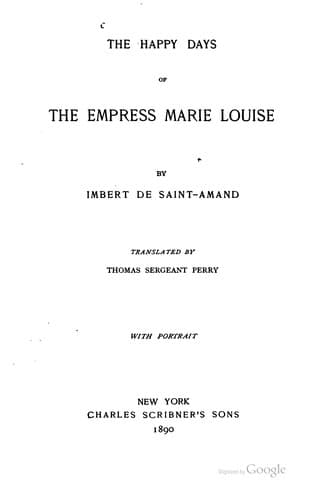
The Happy Days of the Empress Marie LouiseImbert de Saint-Amand
History
The Happy Days of the Empress Marie Louise
Imbert de Saint-Amand
Marie Louise, Empress, consort of Napoleon I, Emperor of the French, 1791-1847
ladies-in-waiting of the Princesses, the ladies and officers of Their
Imperial Highnesses on duty.
When the procession had taken their places according to their rank,
the Grand Almoner intoned the _Veni Creator_, and the governess having
carried the child to the railing of the choir, he went through the
preliminary rites, and then took place the baptism. As soon as the
Imperial child had been baptized, the governess placed him in the hands
of the Empress; the First Herald-at-Arms advanced to the middle of the
choir and called out three times, "Long live the King of Rome!" Cheers
and applause, which till that moment had been restrained by the sanctity
of the ceremony and the solemnity of the place, then broke forth on all
sides. While they lasted, Marie Louise stood with the child in her arms;
the Emperor then took him and held him aloft, that all might see him.
Thiers thus comments in a page of real eloquence on this imposing
spectacle: "What a solemn mystery surrounds human life! What a painful
surprise it would have been, if beyond this scene of power and
greatness, one could have seen the ruin, the blood, the flames of
Moscow, the ice of the Beresina and Leipsic, Fontainebleau, Elba, Saint
Helena, and finally the death of this prince at the age of twenty, in
exile, without one of the crowns he wore that day upon his head, and the
many revolutions once more to raise his family after overthrowing
it! What a blessing that the future is hidden from man! But what a
stumbling-block for his prudence, charged to conjecture the morrow and
to guard against it with all one's wisdom."
When the governess had again taken the Prince, she courtesied to the
Emperor, and the King of Rome, with his retinue, left the church, to be
taken to the Archbishop's, whence he returned to the Tuileries. Then the
Grand Almoner intoned the _Te Deum_, which, was performed by the choir,
and followed by the _Domine, fac salvum imperatorem_. The Emperor
and the Empress were conducted with the same ceremonies as at their
entrance, to the church door, where they got into their carriage amid
the cheers of the crowd, and drove to the entertainment at the Hôtel de
Ville.
"The people of Paris admitted to this festivity," says Thiers, "were
able to see Napoleon at table, his crown on his head, surrounded by the
kings of his family and a number of foreign princes, eating in public,
like the old Germanic Emperors, the successors of the Emperors of
the West. The Parisians applauded in their delight at this brilliant
spectacle, imagining that durability was united with grandeur and with
glory! They did well to rejoice, for these joys were the last of the
reign. Henceforth our story is but one long lamentation."
Public-domain text, read in full here on John Shaqi.
Reviews
Reviews
No reviews yet
Be the first to share your thoughts on this work.
Elsewhere in the archive
Join the Discussion
Join the discussion
Sign in to leave a comment or review.
Sign InorCreate an account