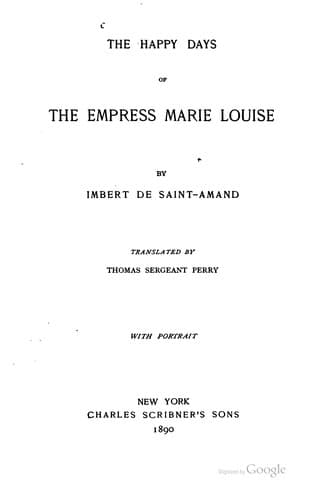
The Happy Days of the Empress Marie LouiseImbert de Saint-Amand
History
The Happy Days of the Empress Marie Louise
Imbert de Saint-Amand
Marie Louise, Empress, consort of Napoleon I, Emperor of the French, 1791-1847
A short time after Wagram Napoleon had been heard, in a levee at which
his generals were present, to lament the bloody campaigns in which he
always lost some of his early companions. "I have been a soldier long
enough," he went on; "it's time for me to be a king." During 1811 he
seemed faithful to this new programme. The soldier had become a monarch,
and the hero of so many battles seemed to be desirous of the glories of
peace. He determined to make a trip in Belgium and Holland and along the
banks of the Rhine, where he should see for himself what the happiness
of the people required. The Empress made the journey with him, but
Napoleon started from Compiègne without her, September 19; she was to
join him on the 30th at Antwerp. At this time she was so attached to him
that she could not endure a separation of only a few days, and she wrote
to her father: "My husband has left to-night to go to the island of
Walcheren, which has the worst climate in the world, so that I could
not go with him, for which I am extremely sorry." While the Emperor was
visiting Boulogne, Ostend, and Flushing, the Queen made her way, with
a magnificent court, to Belgium. She left Compiègne, September 22, and
took up her residence at the castle at Laeken, near Brussels. She often
visited the Belgian capital, which then was only the chief town of a
French department,--the department of the Dyle. Napoleon made a great
point of her appearing in all splendor in the provinces which had
previously been governed by the house of Austria. She went to the
theatre, where she was warmly greeted, and purchased a hundred and fifty
thousand francs' worth of lace to revive the manufactures of the city.
September 30 she joined her husband at Antwerp. The _Moniteur_ thus
spoke of the way the Emperor had transformed this city: "Antwerp may be
considered as a fortress of the rank of Metz and Strasbourg. The work
which has been done there is enormous. On the left bank of the Scheldt,
where two years ago there was only a redoubt, there has risen a city
twelve thousand feet long, with eight bastions.... The view from
the dockyard is unparalleled; twenty-one men-of-war, eight of them
three-deckers, are building. The arsenal is fully provided with
provisions of all sorts brought down the Rhine and the Meuse.
"Seven years ago," continues the _Moniteur_, "there was not a single
quay in Antwerp, and the houses came down to the river's edge. To-day,
in the place of these houses, are superb quays, of service to the
commerce and to the defence of the place. Six years ago there was no
basin, but only a few canals where boats drawing ten or twelve feet
could scarcely enter. To-day there is a basin twenty-six feet deep at
the bank, able to hold ships-of-the-line, with a lock for the admission
of ships carrying a hundred and twenty guns."
Public-domain text, read in full here on John Shaqi.
Reviews
Reviews
No reviews yet
Be the first to share your thoughts on this work.
Elsewhere in the archive
Join the Discussion
Join the discussion
Sign in to leave a comment or review.
Sign InorCreate an account