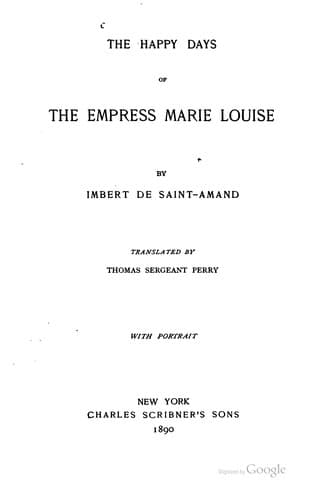
The Happy Days of the Empress Marie LouiseImbert de Saint-Amand
History
The Happy Days of the Empress Marie Louise
Imbert de Saint-Amand
Marie Louise, Empress, consort of Napoleon I, Emperor of the French, 1791-1847
When Marie Louise visited this famous village, the burgomaster, in view
of the importance of the occasion, consented to break the rigid rules
and to permit the Imperial carriage to drive over the mosaic pavement
to his house, where he presented his respects to the Empress. At this
house, as in every one in the village, there are two doors,--one for
daily use, the other opened only for baptisms, marriages, and funerals.
This door, which is called the fatal door, opens into a room which is
always kept shut except on these three occasions. "The Empress," says
M. de Bausset, "asked to have the fatal door opened. We crossed the
threshold with gratified vanity, in the presence of many inhabitants,
who feared to follow us, but who were almost tempted to admire the ease
and courage with which we went in and out. After visiting, admiring,
and praising everything, we left these worthy people delighted with the
touching graces and amiable kindness of their young sovereign."
The Emperor and Empress visited Saardam, where Peter the Great spent
ten months as a workman, to study shipbuilding. Napoleon fell into
meditation before the hut of the famous Czar, as he had done before the
tomb of Frederick the Great. "That is the noblest monument in Holland!"
he said; and in memory of Peter the Great he ordered Saardam to be made
a city.
Napoleon and Marie Louise also spent a few hours at Harlem, a
half-Gothic, half-Japanese town, celebrated by the passion of its
inhabitants for flowers, especially for tulips. October 26, they arrived
at Rotterdam, at Loo on the 27th, and spent the night of the 28th at The
Hague, whence they went to visit the banks of the Rhine. The Emperor
carried away with him a most favorable impression of the Dutch, whose
seriousness, morality, love of order, and industry had continually
struck him, so that he shared his brother Louis's partiality for a
nation as interesting in the present as in the past.
Public-domain text, read in full here on John Shaqi.
Reviews
Reviews
No reviews yet
Be the first to share your thoughts on this work.
Elsewhere in the archive
Join the Discussion
Join the discussion
Sign in to leave a comment or review.
Sign InorCreate an account