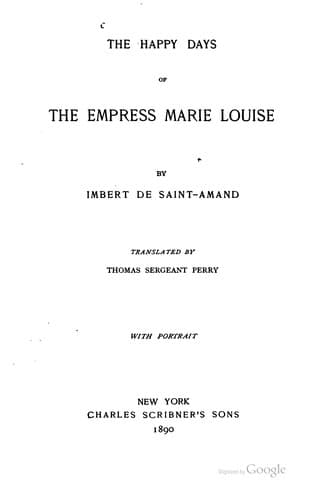
The Happy Days of the Empress Marie LouiseImbert de Saint-Amand
History
The Happy Days of the Empress Marie Louise
Imbert de Saint-Amand
Marie Louise, Empress, consort of Napoleon I, Emperor of the French, 1791-1847
Judging by the words of Cardinal Maury, who had been so famous in the
Constituent Assembly, and had been made Archbishop of Paris by the
Emperor, Napoleon was very much in love with his young wife. "It would
be impossible," he wrote to the Duchesa of Abrantes, "to make you
understand how much the Emperor loves our charming Empress. It is love,
but a good love this time. He is in love with her, I tell you, and as he
never was with Josephine; for, after all, he never knew her when she was
young. She was over thirty when they married, while this wife is young
and as fresh as the spring. You will see her, and you will be delighted
with her.... And then if you knew how gay she is, how pleasant, and,
above all, how thoroughly at her ease with all those whom the Emperor
honors with his intimacy! You will see how lovable she is. People used
to talk about the _soirées_ of the Queen of Holland. I assure you the
Empress is very charming for those whom the Emperor admits informally
into the Tuileries. They go there of an evening to pay their court, they
play with Their Majesties reversis or billiards; and the Empress is so
charming, so fascinating, that it is easy to see from the Emperor's eyes
that he is dying to kiss her."
Probably there is some exaggeration in Cardinal Maury's enthusiasm.
Doubtless Marie Louise pleased Napoleon very much, but had she been a
young woman of humble rank, he probably would not have noticed her. What
he especially admired in her was the Archduchess, the daughter of the
German Caesars, and in the feeling she aroused in him there was perhaps
more gratified vanity than real love. He certainly was not attracted
to her by one of those tempests of passion which had drawn him towards
Josephine; he would not have written to his second wife burning letters
like those he wrote to Josephine during the first campaign in Italy. In
his affection for Marie Louise there was something calm and reasonable,
almost paternal; it was the reflection of maturity succeeding to the
impetuous ardor of youth. Yet he had more deference and regard for the
second Empress than for the first. Shortly after her marriage Marie
Louise said to Metternich: "I am sure that in Vienna people think a
great deal about me, and imagine that I live in continual anguish. The
truth often seems improbable. I am not afraid of Napoleon, but I am
beginning to think that he is afraid of me."
It has been said that the Emperor was not perfectly constant to Marie
Louise; but even if he was ever unfaithful, he kept the fact from her
knowledge, and never made his second wife as unhappy as he had made his
first. He used to boast that he cared only for honest men and virtuous
women, and he was anxious that no one should be able to charge him with
setting a bad example. His court had become very strict, at least in
appearance. Decorum prevailed there as rigidly as etiquette.
Public-domain text, read in full here on John Shaqi.
Reviews
Reviews
No reviews yet
Be the first to share your thoughts on this work.
Elsewhere in the archive
Join the Discussion
Join the discussion
Sign in to leave a comment or review.
Sign InorCreate an account