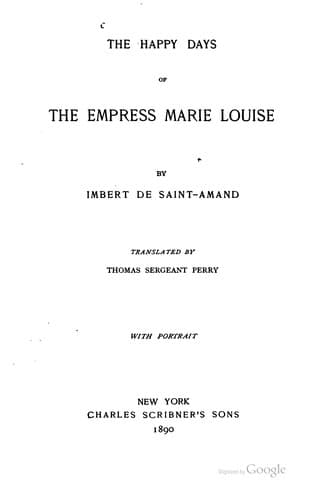
The Happy Days of the Empress Marie LouiseImbert de Saint-Amand
History
The Happy Days of the Empress Marie Louise
Imbert de Saint-Amand
Marie Louise, Empress, consort of Napoleon I, Emperor of the French, 1791-1847
These six ladies had an important position. Not only did they announce
all the Empress's visitors; they also had actual charge of the domestic
service, with six chambermaids under their orders, who only entered
the Empress's rooms when she rang for them, while they, four, being in
attendance every day, spent all their time with Marie Louise. They went
to the Empress as soon as she was up, and did not leave her till she
had gone to bed. Then all the doors of the Empress's room were locked,
except one, leading into the next room, where slept the one of the
ladies in charge, and Napoleon himself could not go into Marie Louise's
room at night without passing through this room. No man, with the
exception of the Empress's private secretary, her keeper of the purse,
and her medical attendants, could enter her apartment without an order
from the Emperor. Even ladies, other than the Lady of Honor and the Lady
of the Bedchamber, were not received there except by appointment. The
six ladies we have mentioned had charge of the enforcement of these
rules, and were responsible for their observance. One of them was
present at the Empress's drawing, music, and embroidery lessons.
They wrote at her dictation, or under her orders. The same etiquette
prevailed when the court was on its travels. Always one of these six
ladies slept in the next room to the Empress, and that was the only
approach to her chamber.
Madame Durand tells vis the goldsmith Biennais had made for the Empress
a letter-case with a good many secret drawers which she alone could
know, and he asked to be allowed to explain it to her. Marie Louise
spoke about it to the Emperor, who gave her permission to receive him.
Biennais was consequently summoned to Saint Cloud and admitted into the
music-room, where he stood at one end with the Empress, while Madame
Durand was in the same room, but so far off that she could not overhear
his explanation. Just when this was finished the Emperor came in, and
seeing Biennais, he asked who that man was; the Empress hastened to tell
him, to explain the reason of his coming, mentioning that he had himself
given him permission. This the Emperor absolutely denied, and pretended
that the lady-in-waiting was to blame; he scolded her so severely that
the Empress could scarcely stop him, although she said, "But, my dear,
it is I who ordered Biennais to come." The Emperor laughed, and told her
that she had nothing to do about it; that the lady was responsible for
every one she admitted, and was alone to blame; and that he hoped that
nothing of the sort would ever happen again.
Public-domain text, read in full here on John Shaqi.
Reviews
Reviews
No reviews yet
Be the first to share your thoughts on this work.
Elsewhere in the archive
Join the Discussion
Join the discussion
Sign in to leave a comment or review.
Sign InorCreate an account