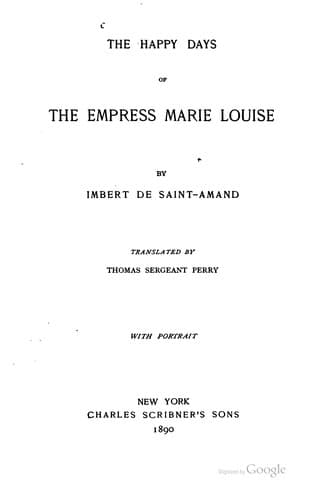
The Happy Days of the Empress Marie LouiseImbert de Saint-Amand
History
The Happy Days of the Empress Marie Louise
Imbert de Saint-Amand
Marie Louise, Empress, consort of Napoleon I, Emperor of the French, 1791-1847
In private life Marie Louise was kind and amiable. She was very polite
and gentle; unlike many princesses, she was not given to fickle
preferences and to infatuations as intense as they were brief; she was
not unjust, violent, or capricious. She was never angry; she did not
give empty promises, or affect any excessive interest, but she could
always be depended on; she never distressed or humiliated any one.
Having been trained from her infancy to court life, she was a kind
mistress, for she had learned to combine two qualities that are often
irreconcilable--dignity and gentleness. All who were thrown into her
society agree in this. Sometimes, according to Madame Durand, when she
was in company her face had a melancholy expression inspired by the
demands of etiquette that were made upon her; but "when she had returned
to her own quarters, she was gentle, merry, affable, and adored by all
who were with her every day.... Nothing was more gracious, more amiable,
than her face when she was at her ease, quietly at home in the evening,
or among those to whom she was particularly attached."
Marie Louise gave a great deal of care to her son, whom she tenderly
loved. She had him brought to her every morning, and she kept him with
her until she had to dress. In the course of the day, in the intervals
of her lessons, she used to visit the little King in his apartment,
and sit by his side and sew. Often she took him and his nurse to the
Emperor; the nurse would stop at the door of the room in which Napoleon
was, and Marie Louise would enter, with the child in her arms, always
afraid that she was going to drop him. Then the Emperor would run up,
take the child, and cover him with kisses.
The Baron de Méneval writes thus: "Sometimes he was seated on his
favorite sofa, near the mantel-piece, on which stood two magnificent
bronze busts, of Scipio and Hannibal, and was busily reading an
important report; sometimes he went to his writing-desk, hollowed in
the middle, with two projecting shelves, covered with papers, to sign a
despatch, every word of which had to be carefully weighed; but his son,
sitting on his knees, or held close to his chest, never left him. He had
such a marvellous power of concentration that he could at the same time
give his attention to important business and humor his son. Again,
laying aside the great thoughts which haunted his mind, he would lie
down on the floor by the boy's side, and play with him like another
child, eager to amuse him and to spare him every annoyance."
Public-domain text, read in full here on John Shaqi.
Reviews
Reviews
No reviews yet
Be the first to share your thoughts on this work.
Elsewhere in the archive
Join the Discussion
Join the discussion
Sign in to leave a comment or review.
Sign InorCreate an account