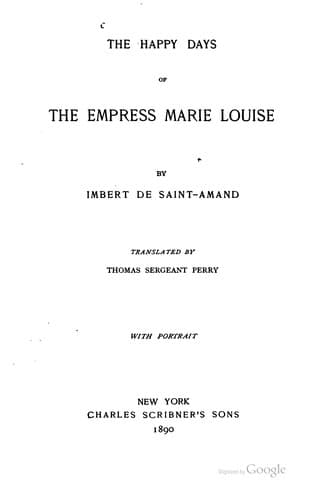
The Happy Days of the Empress Marie LouiseImbert de Saint-Amand
History
The Happy Days of the Empress Marie Louise
Imbert de Saint-Amand
Marie Louise, Empress, consort of Napoleon I, Emperor of the French, 1791-1847
The Prussian Minister, expressing the most unbounded satisfaction,
abounded with praise of the courtesy and kindness of Napoleon. He
concluded his circular despatch thus: "I am obliged to abstain from
going into further details with regard to our Sovereign's reception, and
the subsequent interviews, as well as the court ceremonies and festivals
of this day and the two following; but what I can and must add as an
eye-witness, is, that in general there could have been nothing more
considerate and more friendly than this reception, as well on the part
of His Majesty the Emperor Napoleon, as on that of Their Majesties the
Emperor of Austria and the King of Saxony and their August families,
and that the King has been much gratified by it. The friendship and the
personal confidence of these monarchs and the reciprocal conviction of
the sincerity of their feelings have affirmed themselves in the most
solid way; and especially, the close bonds uniting our Sovereign with
that of France have acquired a new character of cordiality and strength.
I have to add that His Royal Highness the Crown Prince, who reached
Dresden on the 27th, has equally received the suffrages of the
Sovereigns there assembled, and that the Emperor Napoleon greeted him
with affectionate cordiality." Count von Goltz was evidently anxious
that all this should be bruited abroad. The last sentence of the
despatch ran thus, "Although these details are primarily intended for
you, Sir, you are obviously free to make such use of them as you may see
fit." Possibly this sentence meant that when these details might not be
agreeable, that is to say, to the friends of Russia or England, it might
not be well to communicate them.
In fact, not a single Prussian had forgotten Jena; there was not one
who did not yearn for revenge. King Frederic William, who had at first
resolved to withdraw to Silesia, in order not to be in Potsdam under
the cannon of Spandau, or in Berlin under the authority of a French
governor, consented to return to his usual quarters. Although his
minister, Count von Goltz, had represented him as "perfectly satisfied
with the precious days he had spent at Dresden, and deeply touched by
the repeated proofs of friendship, esteem, and attachment that he had
received," this sovereign, though he bowed to the exigencies of the
hour, waited only for a favorable moment to reappear in the front ranks
of his conqueror's foes. In 1816 Napoleon thus judged him: "The King
of Prussia, as a man, is loyal, kind, and honest, but in his political
capacity he is naturally ruled by necessity; so long as you have the
strength, you are his master."
Public-domain text, read in full here on John Shaqi.
Reviews
Reviews
No reviews yet
Be the first to share your thoughts on this work.
Elsewhere in the archive
Join the Discussion
Join the discussion
Sign in to leave a comment or review.
Sign InorCreate an account