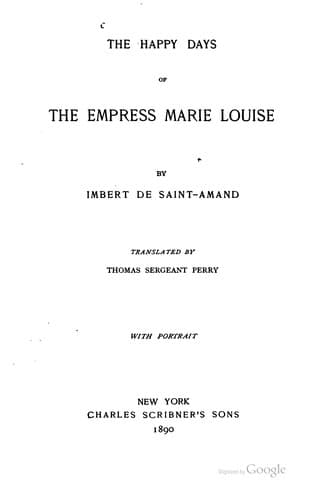
The Happy Days of the Empress Marie LouiseImbert de Saint-Amand
History
The Happy Days of the Empress Marie Louise
Imbert de Saint-Amand
Marie Louise, Empress, consort of Napoleon I, Emperor of the French, 1791-1847
It was a terrible, lamentable war towards which the hero of so many
battles was plunging with a lowered head, as if drawn into the abyss by
a deadly fascination. Sometimes, amid the fumes of power and pride, some
mysterious voice warned him of his peril; but he would reassure himself
by recalling his former victories and thinking of his star. As General
de Ségur has said: "It seemed as if in his doubts of the future, he
buried himself in the past, and that he felt it necessary to arm himself
against a great peril with all his most glorious recollections. Then,
as he has since done, he felt the need of forming illusions about the
alleged weakness of his rival. As he made ready for this great invasion,
he hesitated to regard the result as certain; for he no longer was
conscious of his infallibility, nor had that military assurance which
the force and fire of youth give, nor had he that conviction of success
which makes it sure." There had been no lack of warnings. Those of his
advisers who knew Russia well, such as the Count of Ségur and the Duke
of Vicenza, ambassadors at Saint Petersburg, one under the King, the
other under the Empire, had said to him: "Everything will be against
you in this war. The Russians will have their patriotism and love of
independence, all public and private interests, including the secret
wishes of our allies. We shall have for us, against so many obstacles,
nothing but glory alone, even without the cupidity which the terrible
poverty of those regions cannot tempt." General Rapp, who was in command
at Dantzic, had thought it his duty to inform Marshal Davoust of the
alarming symptoms which he had discovered among the German populace:
"If the French army suffers a single defeat, there will be one vast
insurrection from the Rhine to the Niemen." Davoust forwarded this
information to Napoleon with this single indorsement: "I remember, Sire,
in fact, that in 1809, had it not been for Your Majesty's miracles at
Regensburg, our situation in Germany would have been very difficult,"
The Emperor listened to no one. He did not suspect that the King of
Prussia, seemingly his ally, had sent word secretly to the Czar: "Strike
no blow at Napoleon. Draw the French into the heart of Russia; let
fatigue and famine do the work." Meanwhile the sun was drying the roads;
the grass was beginning to grow. Nature was preparing the earth for the
common extermination of its people. And, oddly enough, at the moment
when the slaughter was about to begin, Napoleon had no feeling of hate
or wrath towards his adversary, the Russian monarch. He was of the
opinion that a war between sovereigns, that is to say, between brothers
by divine right, could in no way affect their friendship. He had
written, April 25, 1812, to the Emperor Alexander: "Your Majesty will
permit me to assure you, that if fate shall render this war between us
inevitable, it cannot alter the feelings with which Your Majesty has
Public-domain text, read in full here on John Shaqi.
Reviews
Reviews
No reviews yet
Be the first to share your thoughts on this work.
Elsewhere in the archive
Join the Discussion
Join the discussion
Sign in to leave a comment or review.
Sign InorCreate an account