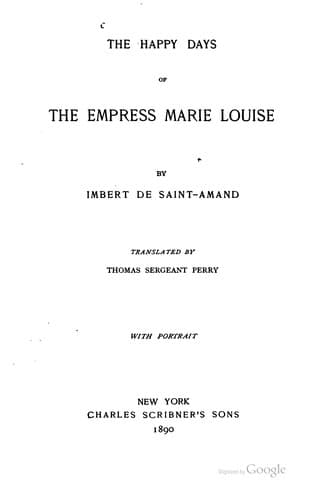
The Happy Days of the Empress Marie LouiseImbert de Saint-Amand
History
The Happy Days of the Empress Marie Louise
Imbert de Saint-Amand
Marie Louise, Empress, consort of Napoleon I, Emperor of the French, 1791-1847
So far from her husband, her guide and protector, Marie Louise felt
alone and strange in the grand palace of Saint Cloud. It was then that
she began to suffer from those attacks of homesickness which made her
long for the neighborhood of Vienna. Up to that day there had been
nothing but fairy-like splendor; the young sovereign had seen only the
brilliant side of the Empire. A vague presentiment made her fear that
she was to see the other side. Napoleon had not been able to make his
wife share his boundless confidence in himself. She would have been
tempted to apply to all she saw these words from the "Imitation": "The
glory which comes from men passes quickly away.... The glory of this
world is never void of sorrow." Napoleon had just said in his last
proclamation: "Russia is led by fatality. She must fulfil her destiny."
Alas! it was not Russia, it was France; it was the Emperor who was led
by fatality. The army had crossed the Niemen June 24. As the national
historian has said, "We shall find glory at every step; but we must not
look for good fortune beyond the Niemen." Up to this point every one
looked upon Napoleon as invincible, and his young wife had imagined that
he was the incarnation of success. This false idea soon vanished. Marie
Louise's happy days were over.
In our book about the Empress Josephine we regretted that Napoleon had
not oftener sought her advice. We may say the same thing regarding
the second Empress. Marie Louise was very young and inexperienced,
especially in matters of statesmanship and diplomacy. Yet her husband,
genius as he was, would have done well to take counsel of her. She loved
peace, did not care for adventure, and she would have dissuaded him from
the Russian campaign. She who had known from infancy the prejudices,
passions, and rancors of the Viennese court, would have warned him
against blind confidence in Austrian promises. But would she have dared
to give even one word of advice to her powerful husband? Had a woman of
twenty ventured to advise the great Napoleon, the modern Caesar, the
second Charlemagne, he would have received the presumptuous child
with a smile. Yet it was she who would have been right, and she would
have prevented the lamentable wreck of the gigantic Empire. How small a
thing is genius, that word we utter with such respect and emphasis! How
petty before God is the greatest of men!
Public-domain text, read in full here on John Shaqi.
Reviews
Reviews
No reviews yet
Be the first to share your thoughts on this work.
Elsewhere in the archive
Join the Discussion
Join the discussion
Sign in to leave a comment or review.
Sign InorCreate an account