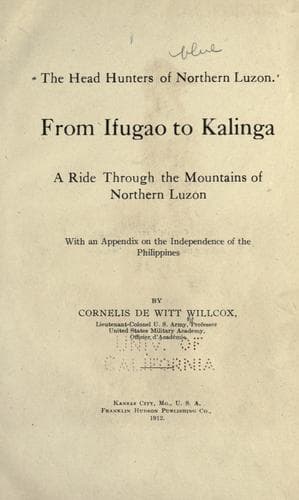
The Head Hunters of Northern LuzonWillcox, Cornélis De Witt
History
The Head Hunters of Northern Luzon
Willcox, Cornélis De Witt
Igorot (Philippine people); Luzon (Philippines) -- Description and travel
And yet upon our declaration of a
policy hangs their future. The matter in its interest and importance is
national; equally national is the indifference we have displayed with
respect to its settlement. Both the United States and the Philippines
are entitled to a decision.
II.
At the outset of any consideration of the question in hand, it is
obvious that we are not shut up _à priori_ to any one solution. Thus,
we may decide, to keep the Islands, or we may grant them immediate
independence, or independence at some future date; we may establish a
protectorate, or give a qualified independence, or even turn them over
to some other power--for example, England or Japan; or, finally, we
may secure an international agreement to neutralize the Islands, thus
ostensibly guarding them against the ambitions of powerful neighbors
of colonizing disposition. All of these solutions have at one time
or another been mentioned; not one of them has ever been officially
announced by the Government, or ratified by the people. Although they
are all possible, yet a moment's thought shows that they are of very
different weight: it is hard to conceive, for example, of our turning
the Islands over to England. Excluding, then, cession to any foreign
power, we may roughly arrange the various possibilities in a scale,
as it were: (_a_) absolute retention; (_b_) qualified retention; (_c_)
protectorate; (_d_) neutralization; (_e_) international independence
at some future date; (_f_) immediate international independence. On
examining this list thus arranged, certain deductions appear. The
stated various possibilities are not all independent, nor are they
all exclusive one of the others. Thus (_a_) excludes all the rest, or,
better, implies (_b_), (_c_), and (_d_), and excludes (_a_) and (_f_);
(_b_) and (_c_) between them are not independent, since a qualified
retention may pass into a protectorate. Neutralization not impossibly
may ultimately call for a protectorate. Future, independence, so
long as unaccomplished, implies (_a_), (_b_), (_c_), and (_d_), while
(_f_) is completely exclusive. It may, however, not prevent foreign
absorption, if, once out, we stay out.
We shall not here take up all of these possibilities. Whatever other
conclusion may be reached, the American people must first pass, either
tacitly or explicitly, on retention or independence. If either of these
extreme be selected, the other possibilities go by the board. If both
are rejected, the remaining four will then have their day in court.
Our immediate purpose, then, is to discuss the question with which
this investigation opens, with the definite purpose of suggesting,
if not of reaching, conclusions that may help others in forming a
decision. It is only when individual decisions have so increased in
number as in some sort to form a body of public opinion that future
action, whether for or against independence, is to be expected.
III.
Public-domain text, read in full here on John Shaqi.
Reviews
Reviews
No reviews yet
Be the first to share your thoughts on this work.
Elsewhere in the archive
Join the Discussion
Join the discussion
Sign in to leave a comment or review.
Sign InorCreate an account